
Wednesday, December 21, 2016


had a kombi and went racing... on the cheap

‘DW Racing Enterprises’ Bob Anderson loads his Brabham BT11 Climax onto his kombi at the Dutch GP Zandvoort 1966 for the long drive back to the UK


https://primotipo.com/2015/09/18/formula-1-privateers-bob-anderson-brabham-bt11-climax/
look closely at the new car before you buy it and drive away...

Scratches from feral cats trying to jump on it?

Keyed in the lot by some pissed off almost customer

Factory paint defects


paving parking lots, pays a lot better than you think


the lowest paid guy gets about 20 an hour on most jobs.
but in the jobs where it's a govt contract (schools etc) they have to get paid "prevailing wages" and the lowest paid guy gets about 50 an hour to shovel asphalt.
No one on this crew doesn't own their own house, here in San Diego. The median cost of a house in San Diego is 300,000 dollars.
Mike Rowe was right, dirty jobs pay well.

Available this week only, on Redbull.tv - The Distance Between Dreams, a surfing video
if it looks like something you want to see, click over to https://www.redbull.tv/video/AP-1P24G4XB12111/distance-between-dreams?playlist=AP-1P24G4XB12111 before Dec 25th


In April of 1963, a devastating massive fire strained the NYC fire service to the absolute breaking point while destroying millions of $ of property, so they decided that WASN'T going to happen again, and developed the Mack Super Pumper system


The truck, tender, and satellite units were all housed in a specially built station that was located to give them the best response time to downtown and points outside of the city. Here we see the pumper rig and tender leaving the station. The Satellite trucks would normally get on scene first to lay out their positions and prepare to get hooked to the pump.
Notice that the water cannons are off fire dept boats

Mack was awarded the contract to build the truck in 1964.
The top speed of the whole rig was 42mph but since it was intended for responding to calls in the city, high mph was not as much a concern as maneuverability, and the ability to zip around at lower speeds happily.
In 1967 the Super Pumper responded to a fire at a postal annex in NYC and managed to supply water to the massive gun on the tender truck, its three satellite units, two tower ladder trucks, and a portable manifold with multiple hand lines all by itself.
The hoses on the truck were pressure tested to 1,000psi of pressure but typically operated anywhere in the 350-800psi range depending on the situation. This is way higher what modern trucks use by our understanding. The hoses were a derivative of hoses developed by the Navy in WWII for high pressure applications and while incredibly heavy when compared to modern hoses, they were cutting edge at the time.
The keystone of the whole operation was the massive central pumping unit that could draw water from eight hydrants at once, drop lines into bodies of water, supply a mind-boggling number of lines with water simultaneously, and flow over 10,000 gallons per minute at low pressures if the situation called for it. When the pressure was ramped up to to 350psi, it could move 8,800 GPM. This was enough to supply the other satellite trucks as well as feed a massive water cannon on the tender truck that could heave water over 600ft.
The grunt for the Super Pumper system came from a Napier-Deltic diesel engine. This was an engine designed by the British during WWII as a lightweight, high speed means to propel their ships and locomotives.
Making 2,400 horsepower and even more prodigious torque numbers, the engine was “light” enough to be mounted in a trailer behind a tractor and carted around.
The engine’s design is interesting in the fact that it had three crankshafts and was an opposed piston style engine meaning that the pistons travel at each other.
With turbochargers and a two stroke design, it was as mighty a compact piston powered engine the world had ever known to that point. It was thirsty, 137 gallons of diesel fuel per hour and the noise was so deafening that firemen near the truck had to wear hearing protection.
By the time of its retirement in April 1982, FDNY's super pumper had responded to more than 2,200 calls, and it even took over the task of a failed pumping station in the city's municipal water supply at one time.
There is even a book: "The Super Pumper System" by John A. Calderone - The entire history of the Super Pumper is covered: from its basic concept, awarding of the contract to Mack Trucks in 1963; construction, selection of firehouses and personnel, official acceptance and placement in service in 1965, gradual decline in the 1970’s, and eventual elimination from active service in 1982.

it's now in a museum in Bay City Michigan

http://toyandfiretruckmuseum.org/
http://www.firechief.com/2016/01/08/the-greatest-fire-pumper-the-world-has-known/
http://bangshift.com/bangshiftxl/mack-super-pumper-system-locomotive-engine-powered-pumper-extinguish-hell-often/
The goofballs Bob Hope and Bing Crosby even kept up their fake, but funny, competition with soapbox derby cars for kids

1948 "Paleface Special" and "Emperor Waltz" with Wally Parks between the racers, they are both named for movies that Hope and Crosby released in the theaters that year.
If it had wheels, Wally Parks was interested in it, and these downhill racers were supported by the Hot Rod Magazine and NHRA in early Soapbox Derby programs sponsored by Chevrolet.
https://www.facebook.com/groups/stiffspeed/
Sidenote, celebrities used to go to the National Soapbox Derby, and a list of them is at http://www.soapboxderby.org/aasbd-race-program/history/celebrities.aspx but after the 80s, the star power isn't there at all. I just don't even recognize the names. But back in the 40s and 50s some major celebs showed up, Ron Reagan, Jimmy Stewart, Eddie Rickenbacker, Dizzy Dean, jack Dempsey, General Doolittle, Roy Rodgers, Abbott and Costello, Art Carney, Glenn Ford, the cast of Bonanza, Fess Parker, astronauts Lovell, Ward, and Gordon, Peter Fonda, Evel Knievel, and many others.


1967, Dick Thompson driving for team Shelby. Carroll is looking dressed to the 9s, but check out the rest of the details in the pits... like the tank level indicator hose

I may be wrong, but it looks look a welder with Oxy/Acetylene tanks, a floor jack, one pit crew member with an air impact wrench, and 3 guys loading fuel into the trunk gas cap filler.
I think it's a classy look to have the fuel barrels in the car colors too.
This was at Lime Rock according to the gallery of photos it's mixed in with
http://gwadagone.fotki.com/trans-am-racing1966/?view=roll#206

Tuesday, December 20, 2016


Jack Cole, best known as a cartoon artist in Playboy and for Plastic Man, bicycled solo cross-country at age 17 to Los Angeles, California and back.
He wanted to see the 1932 Olympics so bad, that after getting out of class on the last day of his junior year of high school, he hopped on his bike and headed west from Pennsylvania to Los Angeles. 3 months on the road, 5 bike tires, 40 dollars, and he wrote it up later in a news paper article in 1935. He biked back too, and had returned in time for the start of school, his senior year.
He paid for the Landon School of Illustration and Cartooning correspondence course with his lunch money too.
Remarkable.
Graphically inventive and prone to wild flights of surreal visual hilarity, Cole predated the wit and frenetic comic intensity of Mad magazine and was instrumental in creating the irresistibly lurid crime and horror comic books that provoked the anti-comics hysteria of the same decade.
The sight gags in Plasticman are famous among cartoons, as Plasticman could spread himself over any object to blend in so crooks couldn't see him, except the colors were always red, black, and yellow.

He later worked with Will Eisner on the Spirit, then in 1954 went to work for Hugh Hefner and Playboy

After having drawn slightly risqué, single-panel "good girl art" cartoons for magazines, using the pen name "Jake", Cole was hired by Heff.

Under his own name, he produced full-page, watercolored gag cartoons of beautiful but dim girls and rich but equally dim old men. Cole's art first appeared in the fifth issue; he would have at least one piece published in Playboy each month until his suicide in 1958.

So popular was his work that the second item of merchandise ever licensed by Playboy (after cufflinks with the famous rabbit-head logo) was a cocktail-napkin set, "Females by Cole", featuring his cartoons.
https://en.wikipedia.org/wiki/Jack_Cole_(artist)
He paid for the Landon School of Illustration and Cartooning correspondence course with his lunch money too.
Remarkable.
Graphically inventive and prone to wild flights of surreal visual hilarity, Cole predated the wit and frenetic comic intensity of Mad magazine and was instrumental in creating the irresistibly lurid crime and horror comic books that provoked the anti-comics hysteria of the same decade.
The sight gags in Plasticman are famous among cartoons, as Plasticman could spread himself over any object to blend in so crooks couldn't see him, except the colors were always red, black, and yellow.

He later worked with Will Eisner on the Spirit, then in 1954 went to work for Hugh Hefner and Playboy

After having drawn slightly risqué, single-panel "good girl art" cartoons for magazines, using the pen name "Jake", Cole was hired by Heff.

Under his own name, he produced full-page, watercolored gag cartoons of beautiful but dim girls and rich but equally dim old men. Cole's art first appeared in the fifth issue; he would have at least one piece published in Playboy each month until his suicide in 1958.

So popular was his work that the second item of merchandise ever licensed by Playboy (after cufflinks with the famous rabbit-head logo) was a cocktail-napkin set, "Females by Cole", featuring his cartoons.
https://en.wikipedia.org/wiki/Jack_Cole_(artist)

maybe a change is coming to get construction vehicles onto natural gas and off diesel?


Looks like the natural gas burner above is brand new, and the diesel burner below is going extinct




keep looking around, and you see some things.. like a rally Barracuda in the back of the Beast of Turin build video

https://youtu.be/eToHTf-QUBA
http://www.jalopyjournal.com/forum/threads/1911-fiat-s76-runs-for-1st-time-in-over-100-years.953673/


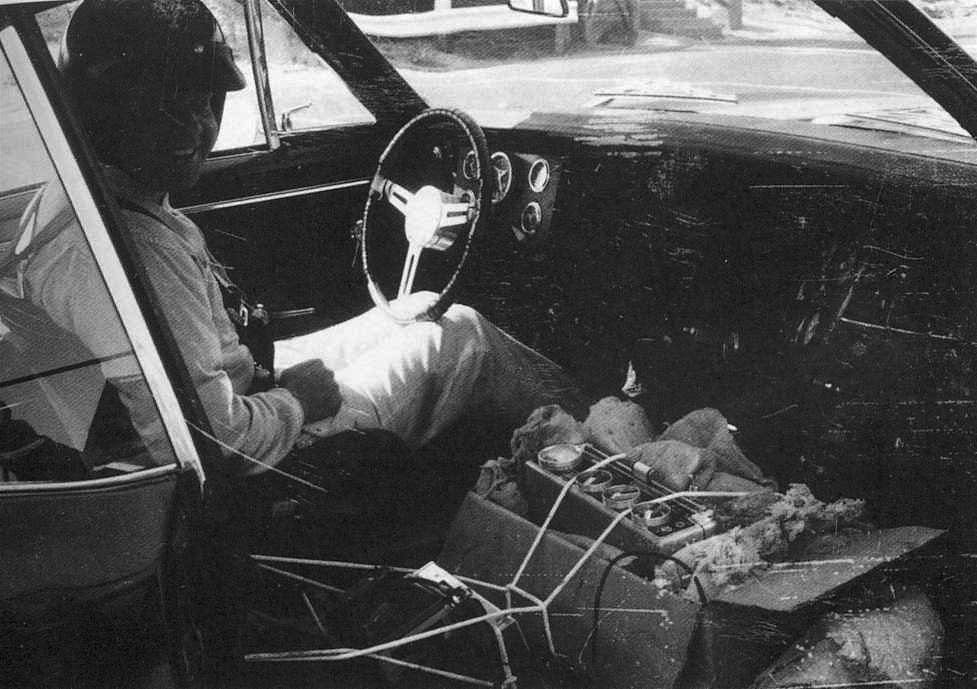
The Plymouth Barracuda Formula S was entered by the factory backed Team Star-Fish in the American Trans-Am racing series with drivers Richard Petty, Scott Harvey, Bruce Jennings and Charles Rainville.


A quote from Paul, the son of the late Charlie Rainville; " Do you recall the photo of dad and AJ crossing the start/finish line side by side on the first lap with the rest of the field not yet in sight at Sebring 66 ? Dad used to say "What that picture didn't show was that he and AJ were giving each other the finger"

https://revslib.stanford.edu/catalog/cx702mj5051

The FIA requirement of a manufacturer building 500 models identical to what was applying to be raced was not adhered to very closely, Enzo made 33 of the 250 GTOs instead of 100, and how many of these race 1966 Barracudas do you think they made with plexiglass rear windows, 40 gallon fuel tanks, 318 engines, and headers?


http://www.teamstarfish.com/team_starfish.html
http://www.cckhistoric.com/tag/team-starfish/
http://gwadagone.fotki.com/trans-am-racing1966/?view=roll#80
Subscribe to:
Posts (Atom)