Kaiser hated the car, of course, and it nearly didn’t make it past the prototype stage—except that Kaiser had brought his wife along to see it, and she declared that the car was the most beautiful thing she’d ever seen.
Showing posts with label Kaiser. Show all posts
Showing posts with label Kaiser. Show all posts
Saturday, January 17, 2026
the Kaiser Darrin prototype was first unveiled at the Los Angeles Motorama in 1952, just two months before the Corvette.
Automotive stylist Howard “Dutch” Darrin took it upon himself to create the fiberglass-bodied roadster himself, proof of concept for the industrialist Henry J. Kaiser, who was staunchly committed to the production of family cars.

Monday, November 17, 2025


Friday, January 24, 2025


Wednesday, February 07, 2024

Thursday, February 09, 2023


Sunday, November 06, 2022
real patina and lettering on this '64 M677 which used to be used to trim trees

Originally painted army green from the factory with military issued heavy duty bumpers
When these trucks were special ordered, Kaiser would actually join two FC cabs together to make a double cab, 2 cabs were brought together and another roof section was spliced in.
The rear doors were actually front doors with bottoms fabricated and welded onto them to cover up the front tire area. Whatever they could do to save money and efficiency at the factory they would.


Originally this vehicle was military green and then painted Mopar green by its new owners at Joe Webster Tree Service in Huntsville Alabama. For many years this vehicle was Joe’s personal truck through the mid 70s and 80s and was then retrofitted with a sprayer in the bed to defoliant High-Tension power lines and radio tower as seen on the door picture. It was later sold off to a local farmer where it was used for truck duties around the farm. We tracked down this information by reading the very faded phone number on the side of the truck and doing a general google search finding out the company was still around.


Friday, September 23, 2022
Gary Kuchar's collection is coming to the Van Der Brink auction, and he had a hell of a wide variety of cars in his collection


that Mustang above the windshield? NOPE. This collection was picked over before the left overs were listed for auction. Most of them don't run, and you will see a Bobcat moving them for photos. But then, at these prices, you're paying for the rust free bodies, not running cars.


DeSoto Airflow

no info on the engine


has a 400 cu in. So, wtf is that doing in there? But it's a Phoenix, and those are cool


401 AMX Javelin


see the Bobcat? And this seems to be the only Mustang getting sold
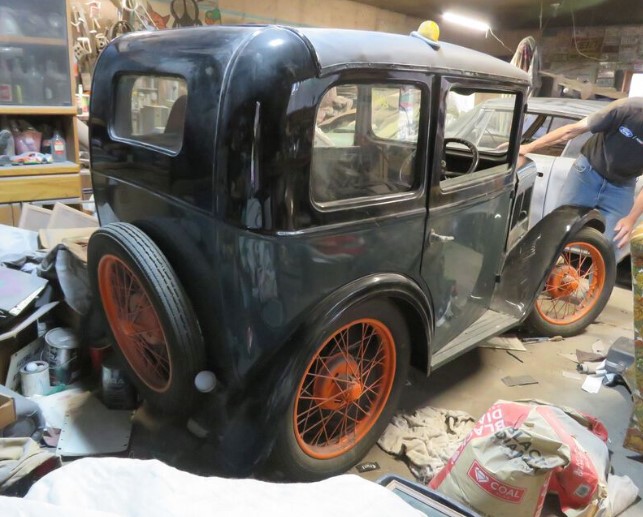
Damn. I wish I could afford to buy this Bantam. I'd be so damn happy.
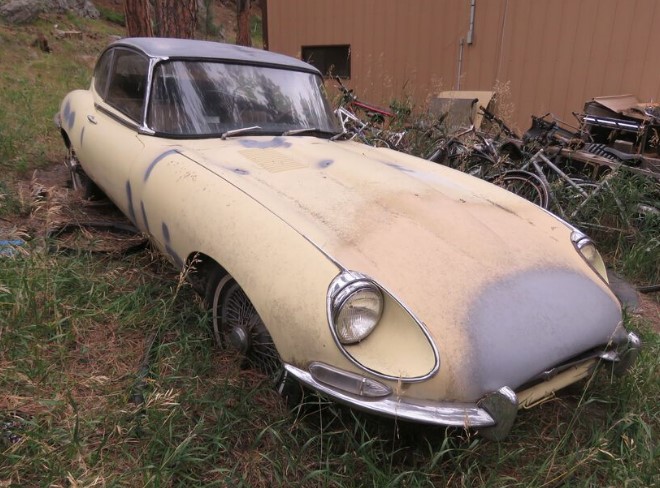
but someone that has always wanted an E Type Jag is going home thrilled!
there's a bunch of other cars, and trucks, and Scouts, etc etc
Wednesday, July 27, 2022


Sunday, May 29, 2022
A fringe benefit for Doctors working in the Kaiser Permanente Health System was they were given Kaiser cars to drive.

In the days before 1952, doctors used the company car to make house calls ($5 per visit). The physicians had a choice of vehicles; most chose one of the sedans. But Ed Schoen, a pediatrician who joined KP in 1954, saw the Kaiser-Darrin as an apt ride for a bachelor relocating from Boston to the San Francisco Bay Area.
The Darrin had originally retailed for $3,600. Schoen got his with 6,000 miles on it for $900. He would drive the unusual sports car exclusively for the next eight years
What has 24 cylinders and goes 180 miles an hour? One of Henry J. Kaiser’s hydroplanes, of course. (Top photo, HJK was 73 yrs old)

The U-21 designation first appeared in 1949 on Henry J. Kaiser's ALUMINUM FIRST.
Henry J, unfortunately, knew just enough about hydroplane design to be dangerous.
The industrialist founder of Kaiser Permanente and his son Edgar loved racing boats at Lake Tahoe, and in 1955 their boat’s heart was a 24-cylinder Allison V-3420 capable of putting out a staggering 2,885 horsepower.

For comparison, the triple-expansion steam engines that powered Kaiser's World War II Liberty ships put out 2,500 horsepower.
This boat began as Henry J. Kaiser’s Scooter, powered by two powerful Cadillac engines and described as a “real plush boat.” But when Scooter was smoked by a “little kid with a B-class hydro” Henry resolved to amp it up.
After World War II, many kinds of military airplane engines were readily available, but this was an experimental design built by General Motors, a Frankensteinian jam-up of a two Allison V-1710 12-cylinder engines with a common crankcase.
One challenge was the single drive shaft, because the torque was enormous. After several shafts broke, Kaiser ordered one made out of titanium.
this beast never performed as hoped. She threw propellers, sank six times, was derisively nicknamed "the submarine," and never won a race.
The Kaisers sold her in 1957 to Stanley Adams and John Owsley for $4,500 and she was trailered to Pasco, Wash. The sale include numerous spare parts, including 72 pistons, 18 connecting rods, and an incomplete second engine. The external oil tank was pulled from a P-51 Mustang.
Rich people race stuff, and Lou Fageol was racing an 800hp boat, "So Long"
Henry J Kaiser Jr was racing the Hornet II
in the July 1938 Lake Tahoe race https://www.parks.ca.gov/pages/510/files/Mercury_Interpretive_Plan_1.pdf
Lou’s father, Frank Fageol, was the head of the Fageol Twin Coach Company, which manufactured buses. After the war, Lou became President of the company and, together with Dan Arena, started the 7-Litre Class. The engine of choice in the 7-Litre Class was the 404 cubic inch Fageol bus engine.
With Fageol at the wheel, Slo-mo became the first craft in history to average 100 miles per hour in a heat of competition around a closed (5-nautical mile) course. it was 1950
In winning the 1951 Gold Cup, Lou became but the third competitor in history to capture both of power boat racing’s crown jewels: The Harmsworth Trophy and the Gold Cup. The two previous double champions were Fred Burnham and Gar Wood.

The result was the Kai won two of four races and nearly missed winning the National High Point Championship.
Kaiser deserves credit equal to anyone with stars on their shoulders when it comes to winning World War II for the Allies. He started out in Portland, Oregon, before setting up a massive network of shipyards in Richmond, California. The enormous yard was the first “integrated” fabrication facility on the West Coast, as Kaiser built his own steel mill there, taking a page from Henry Ford’s playbook when he built the sprawling River Rouge complex.
Welsch continued to race Hawaii Kai for Kaiser in 1957, winning the High Point Championship by sweeping the last five races of the year. After the season Hawaii Kai set a mile straightaway record of 187 m.p.h. including a run through the kilometer trap at 200 m.p.h. The team then retired. However, in the ten years of Kaiser participation in Unlimited racing, they never won a Gold Cup. This factor led to a Kai comeback for the 1958 Gold Cup. In the short period of three weeks a winter's work was done and the Hawaii Kai III became Gold Cup champion, scoring a perfect 2000 points. This was Kaiser's last hurrah.
If you want to look up other racers and owners, see http://hydroplanehistory.com/personalities/
in 1949 Kaiser's boat, designed to go 160 to 180 mph, was to
be piloted by the famous bandleader and speedboat racer, Guy Lombardo.
Kaiser maintained a summer home at Lake Placid, where he pursued racing with his neighbor and friend band leader Guy Lombardo.
In 1949 the Ticonderoga Sentinel noted: “For the second successive week end, Henry J. Kaiser has visited Lake Placid to check on the progress of his two big speed boats. Guy Lombardo also appeared here Saturday to try out the massive 32-foot Aluminum First, with which he will try to break the world’s mile straightaway record in the time trials.”
For the 1949 Harnsworth
International Speed Boat Race, first prize was a four-door Chrysler sedan.
A bit of history of Kaiser, which I've never looked into:
Though he admitted never having seen a ship launched previously, Kaiser did the impossible, building Liberty and Victory ships on an assembly line basis, something never previously attempted. To speed construction, Kaiser specified that the ships be welded together from steel sheet rather than using time-consuming hot rivets. To the astonishment of many, it worked. Kaiser employees (including hundreds of women) sent 1,490 ships down the Richmond ways through the end of the war, providing crucial ocean transport for war matériel as the invasion of Europe drew closer. In another advance, their hulls served as the basis for some of the U.S. Navy’s first light aircraft carriers.
demand for cars would explode after World War II ended. This, of course, became Kaiser-Frazer, formed in 1945 after Kaiser had not-too-subtly teased the public about getting into the car business. The actual partnership between the men was unconventional, Kaiser being the do-it-all business mogul and Joseph Frazer, a former protégé of Walter P. Chrysler who had run Willys-Overland before buying a controlling interested in the staggering brand that was Graham-Paige, which gave the new firm its first dedicated assembly facility in Detroit. That changed soon as Kaiser took over the gigantic assembly plant at Willow Run, Michigan, where Henry Ford had been building B-24 Liberator bombers during the war.
Joseph Frazer left the company in 1953, the same year that the now-redubbed Kaiser Motors acquired Jeep from the remnants of Willys-Overland.
Kaiser did continue to build his cars successfully for some time thereafter in venues that ranged from Argentina and Brazil to Israel. The firm kept manufacturing Jeeps as Kaiser, before his death in 1967, contemplated leaving the auto business entirely. The deal that sold Jeep to American Motors was consummated in 1970. In addition to his civil engineering triumphs, Kaiser’s greatest legacy is Kaiser Permanente, the health-care consortium that he founded for his workers in 1945. It grew by the 21st century to become the largest managed-care provider in the United States.
It’s not commonly known that years earlier, at the end of 1942, Henry J. Kaiser paid Bucky Fuller to engineer and produce a ¼ scale model Dymaxion, to be completed in early 1943. At that time Henry Kaiser was committed to various wartime vehicle projects under federal support, including building cargo ships and “baby flat top” aircraft carriers, prototyping lightweight jeeps, and even experimenting with giant flying wings. So it should come as no surprise that, with the support of the Board of Economic Warfare (on which Fuller served as staffmember), he explored the advantages of Fuller’s Dymaxion.
demand for cars would explode after World War II ended. This, of course, became Kaiser-Frazer, formed in 1945 after Kaiser had not-too-subtly teased the public about getting into the car business. The actual partnership between the men was unconventional, Kaiser being the do-it-all business mogul and Joseph Frazer, a former protégé of Walter P. Chrysler who had run Willys-Overland before buying a controlling interested in the staggering brand that was Graham-Paige, which gave the new firm its first dedicated assembly facility in Detroit. That changed soon as Kaiser took over the gigantic assembly plant at Willow Run, Michigan, where Henry Ford had been building B-24 Liberator bombers during the war.
Joseph Frazer left the company in 1953, the same year that the now-redubbed Kaiser Motors acquired Jeep from the remnants of Willys-Overland.
Kaiser did continue to build his cars successfully for some time thereafter in venues that ranged from Argentina and Brazil to Israel. The firm kept manufacturing Jeeps as Kaiser, before his death in 1967, contemplated leaving the auto business entirely. The deal that sold Jeep to American Motors was consummated in 1970. In addition to his civil engineering triumphs, Kaiser’s greatest legacy is Kaiser Permanente, the health-care consortium that he founded for his workers in 1945. It grew by the 21st century to become the largest managed-care provider in the United States.
It’s not commonly known that years earlier, at the end of 1942, Henry J. Kaiser paid Bucky Fuller to engineer and produce a ¼ scale model Dymaxion, to be completed in early 1943. At that time Henry Kaiser was committed to various wartime vehicle projects under federal support, including building cargo ships and “baby flat top” aircraft carriers, prototyping lightweight jeeps, and even experimenting with giant flying wings. So it should come as no surprise that, with the support of the Board of Economic Warfare (on which Fuller served as staffmember), he explored the advantages of Fuller’s Dymaxion.
Re: homes and such
A retreat in Lake Tahoe,
A summer place in Lake Placid
The shipyards of Richmond Ca, in San Francisco bay,
A home in Lafayette Ca, which is nearby San Francisco Bay, and where they started a school for nurses
the Kaiser Foundation School of Nursing,
the Oakland Medical Center is commemorating the school and its graduates at the Oakland site because the new facility campus encompasses the site of the old hotel that served as the school for nearly 30 years.At the end of World War II when the health plan opened to the public, qualified nurses were in short supply. Kaiser Foundation established the nursing school in 1947 to train more nurses and help alleviate the shortage.
With approval from the California Board of Nurse Examiners, Henry J. Kaiser and founding physician Sidney Garfield, MD, purchased the Piedmont Hotel at 3451 Piedmont, a block away from the hospital.
The accredited Permanente School of Nursing graduated its first class in 1950 and offered tuition-free education and training for its first seven years. In 1953 the name of the school was changed to Kaiser Foundation School of Nursing
What the hell is the word Permanente? and what does it have to do with Kaiser? Well, it's his cement co.
Kaiser claimed he could cut loading and unloading times by as much as 80 percent by pumping bulk, dry cement from ship holds into storage silos in Honolulu. Cynics said the cement would be ruined, but Kaiser guaranteed the product “…from our San José plant to the wheelbarrow in Hawaii.”
In October 1940, Kaiser purchased an aging freighter (the Ancon) from the Panama Canal Company and converted it to a bulk cement carrier. The ship went into service as the Permanente in March 1941 under contract with the U.S. Navy.
The Permanente was moored at Pearl Harbor when it was bombed by the Japanese on December 7, 1941. The ship was not damaged and had already offloaded its holds when the attack came. Within a few days the silos holding the offloaded cement were emptied for the emergency rebuild of the harbor.
Kaiser built a cement plant on Oahu in the 1950s.
At age 84, Kaiser went on to build a new empire in Hawaii, including the elaborate Hawaiian Village hotel complex in Waikiki (now owned by Hilton) and Honolulu’s Hawaii Kai residential community. Kaiser married Alyce after the death of his first wife, and after Kaiser’s funeral, she moved to Greece. She sold all of the properties she shared with Henry.
So he, in essence, gave up close to $200 million of his own shares in Kaiser Aluminum and other companies to repay Kaiser Motors’ debts and make its shareholders whole. Contrast this with Studebaker. When Studebaker shuttered its auto operations in South Bend, Indiana, the company did not fund its pension liabilities, costing Studebaker employees and retirees their retirements.
Saturday, October 16, 2021


Wednesday, August 18, 2021
I just learned the Kaiser Waimea still exists! It was at the Amelia Island Concours this year, and Lane Motor Museum bought it
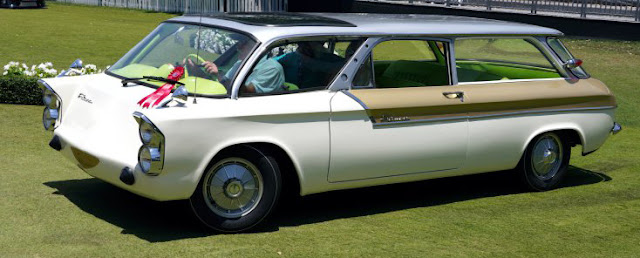
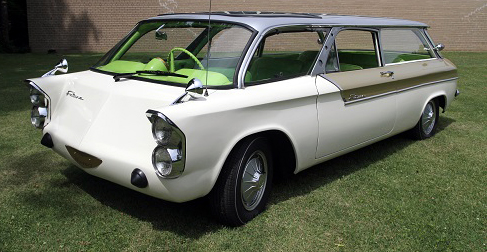
A year after starting the automobile company Kaiser-Frazer, Kaiser also formed Kaiser Aluminum and commissioned Rhys Miller and Frank Hershey (designer of the original 56-57 Ford Thunderbird two-seater) to produce a portfolio of all-aluminum car designs to feature in promotional literature.
The Miller and Hershey futuristic Kaiser prototypes never made it past the drawing board. But in the 90s, automotive restorer, Blake Larson of Minnesota pulled out his collected Kaiser Ads from the 60s and was taken by one singular design, the “Waimea”. Rhys Miller is solely credited to the Waimea design. Intrigued by its unusual middle driver’s seat position with center steering, Larson decided it was time to bring the design to life.Larson showed his newly-finished Futura Waimea around Minnesota in the 90s but then it disappeared. In 2013, it turned up on eBay and was purchased by Wayne Carini. Lane Motor Museum acquired this car in 2021.
Wednesday, May 19, 2021

Saturday, April 10, 2021
Helen Longstreet married Confederate general John Longstreet when she was 34, and he was 76. At age 80 she was building B-29 bombers during World War II.

There are so many incredible stories that we'll never hear of in our lifetimes, be sure to write your biography for your descendants
http://www.longstreetsociety.org/helen-dortch-longstreet.html
https://dailytimewaster.blogspot.com/2021/04/80-year-old-helen-longstreet-widow-of.html
Helen Dortch was born in Carnesville, Georgia, and attended Georgia Baptist Female Seminary (now Brenau College) and the Notre Dame Convent in Maryland.
Having met Longstreet through her roommate, she married him on September 8, 1897, when she was just 34 and he was 76. She was widowed in 1904.
Prior to marrying Longstreet, she was the first woman in Georgia to serve as Assistant State Librarian in 1894. She also authored the "Dortch Bill" (which became law in 1896) to allow a woman to hold the office of State Librarian.
During World War II she was a Rosie the Riveter at the Bell Aircraft plant in Atlanta. She said, "I was at the head of my class in riveting school. In fact I was the only one in it."
In 1943, at the height of World War II, the widow Longstreet took a job as a riveter at a B-29 aircraft factory in Marietta, Ga. She was 80, described as “frail but vivacious,” yet was determined to contribute as she could. “This is the most horrible war of them all,” she told a reporter. “It makes General Sherman look like a piker. I want to get it over with. I want to build bombers to bomb Hitler.”
She worked in the factory for two years, refused to join the union, never missed a day of work or showed up late for a shift. Widow Longstreet told Life magazine reporters, surprised to find a Civil War General’s widow alive and well and working for the war effort, “I just want to build bombers to bomb Hitler.”
Dortch refused to give her age to the reporter, claiming only that she was “older than 50,” and added: “Never mind my age. I can handle that riveting thing as well as anyone. I’m intending to complete in five weeks three courses which normally take three weeks.”
She lived in a trailer camp near the factory and spent long hours in training to learn her craft. “I could not stay out of this war,” she said. “It’s not the soldiers fighting soldiers like it used to be. It’s a war on helpless civilians, on children and the infirm. They are the ones who suffer. Lee, my husband, and many another southerner proved that Americans surrender only to Americans, so we are bound to come out victorious.”
In 1947, she became the first woman to have her portrait placed in the State Capitol.
He contracted pneumonia and died in Gainesville, Georgia on January 2, 1904, six days before his 83rd birthday. Longstreet outlived most of his contemporary detractors, and was one of only a handful of Civil War Generals to live into the 20th century.
For the next 58 years, Helen Longstreet worked tirelessly to rebuild the General’s tattered legacy.
Helen Dortch Longstreet earned the nickname of the “Fighting Lady” for being a champion of many causes including environmental preservation, physical fitness, women’s rights, civil rights and as a Confederate memorialist. She was the first woman to run for public office in the state of Georgia and was thereby instrumental in breaking down the prejudice against women holding high political positions.
Mrs. Longstreet detailed her plan to raise funds for the Longstreet Monument by awarding a new 1949 Kaiser-Frazer automobile to the “prettiest girl in the County whose citizens make the largest contribution to the Longstreet Memorial Association in proportion to population.” Mrs. Longstreet states, “I thought this would cause the ordinaries to contribute and to appeal to their friends for contributions…I would risk my life on the bet that this plan will prove a glorious success.” Mrs. Longstreet’s ambitious plan included buying 48 Kaiser-Frazer cars (at $ 2,000 each) on credit to be awarded in all 48 states.
Not only did she organize the Longstreet Memorial Association, she created both the Longstreet Memorial Exhibit at the New York World’s Fair in 1939 and at the Golden Gate Exposition in San Francisco in 1940.
On July 3 of 1998, one of the last monuments was erected on the Gettysburg National Military Park. It was an equestrian statue of General James Longstreet on his horse “Hero” in Pitzer Woods on Confederate Avenue. Perhaps most astonishingly, 135 years after the battle, Jamie Longstreet Paterson, the 67-year-old granddaughter of General Longstreet was there to see it.
The General James Longstreet Memorial Bridge is an 824-foot long span, built by the American Bridge Company, across the Chattahoochee River.
Wednesday, October 30, 2019
1949-1950 Kaiser DeLuxe Vagabond 4-door utility sedan, not quite a wagon, yet not exactly a sedan in the conventional sense, and without the station wagon look

The design is not unlike a clamshell. Sticking somewhat to conventional styling, the trunk lid hinges were mounted just above the bumper–rather than at the base of the rear window–so that when opened, it would flip down to a position similar to that of a pickup tailgate. The license plate is also hinged so that when the “tailgate” is open, the plate can still be seen. The rest of the notchback rear section, which includes the rear window, can then be opened upward, thanks to hinges just forward of the rear window, and held in place by two reasonably sized locking supports. Depending on the requirements of the driver, the rear seat folds forward offering significantly more cargo area.
The target market for Kaiser’s creation included anyone from hunters to florists, or anyone who had to haul goods such as traveling salesmen, but wanted comfort. Magazines of the day even offered aftermarket attachments that enabled owners to convert their Travelers into temporary campers


https://www.hemmings.com/blog/article/1949-1950-kaiser-traveler-and-vagabond/
https://auto.howstuffworks.com/1949-1953-kaiser-traveler-vagabond.htm
https://en.wheelsage.org/kaiser/deluxe/vagabond_4-door_sedan/pictures/b5gg2p/
Subscribe to:
Posts (Atom)