Showing posts with label C 47. Show all posts

Sunday, November 23, 2025

hell of a variety in the scoreboard: paratrooper drops, medevac, glider tows, cargo hauls


I guess the top row is troop drops
Damned if I know what the train is for, cargo?
The flag is for Medevac
But the camel was for the Over The Hump runs 
So, I don't know what the donkey was for
And the bottom row is towing gliders

Wednesday, November 12, 2025

Hugo Mathis of Switzerland is the owner and one of the pilots of the Classic Formation Team, which features a 1943 DC-3 and three Beech 18s, circa 1952 - and now, a B 25

and Ron Kaplan, owner of  Warbird Aviation Art, painted the Doolittle Raider crests on it, and the name.

The War Bird Shop in Madras says the plane is the oldest flying B-25 bomber in the world.

The mechanics found some surprising discoveries were made along the way. 
 “It’s amazing going into some of these aircraft. The one that just took off — as we were taking all the panels apart, we’d start to see signatures of the Rosie Riveters that put it together, in lead pencil in some cases. 

Erickson's Warbird Shop is becoming the 'go-to' place for bomber maintenance and restoration, they have three B-17s and three B-25s! 


and the story really takes off from their - Ron is also the founder and executive director of the Ohio Air & Space Hall of Fame (OASHF) and Learning Center

Ron’s father was a B-25 instructor pilot during WWII and kept flying after the war.

“We flew out of Ohio State [University]’s Don Scott Field [KOSU],” Kaplan said of his father, who had been the fencing coach at OSU and later, as a professor, was also able to rent the school’s aviation department aircraft. 

[Former] Governor [Jim] Rhodes kept ‘Buckeye One,’ the state of Ohio’s C-53, there.

(Since I've never heard of a C -53, I had to look it up) 

Douglas C-53, A military transport aircraft during World War II, a variant of the civilian Douglas DC-3 airliner, specialized for carrying troops with bucket seats and a single entry door, lacking the large cargo door and reinforced floor of the more versatile C-47 Skytrain.

Ron attended OSU for graphic design, started a lucrative T-Shirt career, and transitioned to full-time aviation art and writing, which led to him being recruited onto the staff of the National Aviation Hall of Fame (NAHF) in 1998. 

He spent 19 years at the NAHF, making connections in the aviation world, especially in the warbird community, then founded the OASHF while simultaneously creating a business around aviation artwork, such as nose art painted on metal or stoneware coasters with images of WWII aircraft.

At the 1981 Doolittle Raider Association reunion in Columbus, Ohio Ron was introduced to General [Jimmy] Doolittle and the attending Raiders, and in 1992 he painted an A-2 flight jacket with the Raiders’ crest and an illustration of Doolittle’s B-25 and gifted it to them at their 50th reunion in Columbia, South Carolina.

His occupation and talent resulted in opportunities to know and work with many such legends and icons of aviation such as Joe Foss, Paul Tibbets, Robin Olds, Bob Hoover, Tex Hill, and dozens more.

https://www.warbirdaviationart.com/collections/new-releases
https://www.centraloregondaily.com/news/madras/oldest-flying-b25-bomber-restored-madras-takes-flight/article_2ddda9a9-911b-4d90-b601-024fca73603f.html

The Ohio State University played an integral part in advancing the aeronautics field, while evolving into one of the nation’s premier aviation programs. 

Less than 14 years after the first flight, World War I created the need for qualified military pilots. In spring and summer 1917, the War Department established Schools of Military Aeronautics at eight universities, including The Ohio State University.

The School of Aeronautics opened to teach cadets aircraft construction and maintenance on May 21, 1917, when the first "squadron" or group of 16 cadets reported. As the story goes, the cadets built the aircraft in the aeronautics building, the planes would then be rolled down the hill to the field just east of the Olentangy River, where flight tests and training would ensue.

The university built a second airport on East Broad Street “near the country club,” while also using other local airports such as Sullivant Field on Neil Avenue.

In 1939, Ohio State was one of a number of universities that took part in the Civilian Pilot Training Program, sponsored by the Civil Aeronautics Administration, for the purpose of fostering private flying

In support of its pilot training program, the university, in May 1942, purchased property for the development of an airport. The new facility was located on the outskirts of town, seven miles north of campus in northwest Columbus. 

The first plane to utilize the new airport landed at the field on November 5, 1942. The airport's first two buildings in the spring of 1943, and two 2,200 feet, hard-surfaced runways, taxiways, and aprons in early 1944. Ohio State began offering flight instruction in 1945.

Four Columbus women pilots formed a chapter of the Ninety-Nines organization in 1946. Helen Linn was the assistant coordinator of pilot training at KOSU in 1946.

Ruth Gouthey was Ohio State's first female flight instructor, and helped form the first Columbus chapter of the 99s. 

It became a public-use airport in 1959 upon receipt of federal funding for runway improvements. 

In the 1970s, the University used Douglas DC-3s at the airport to transport university sports teams, faculty, and administration to and from Columbus.

It's now the 5th largest airport in the state of Ohio, and ranks fourth in Ohio in the number of take-offs and landings and within the top 100 general aviation airports nationally.


Wednesday, September 17, 2025

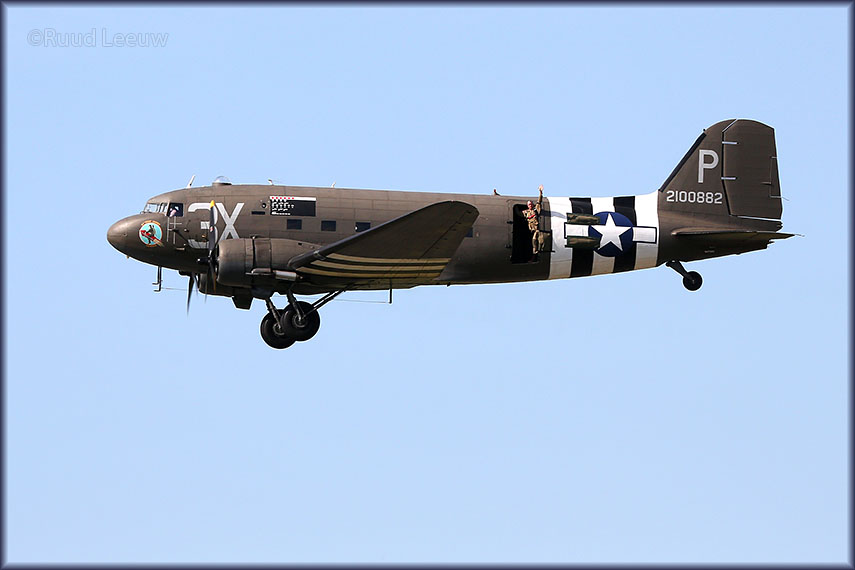
In 1943, the C-47 Placid Lassie took to the skies for the U.S. Army Air Forces, and since that date, it has never stopped, never been restored


While only a handful of bomber and fighter aircraft from the war are still airworthy today, it is estimated that hundreds of C-47s are still airborne around the world — a testament to the design’s durability.

The Placid Lassie is more extraordinary still. While fitted with a new engine, the plane still retains most of its wartime features, replete with the original interior black aluminum paint that factory workers from Long Beach, California, hastily slapped on in 1943.

The Placid Lassie was tasked with ferrying men of the 101st Airborne Division over the English Channel on D-Day; flew four missions during Operation Market Garden; participated in the resupply of the 101st Airborne during the critical days of Dec. 23-26, 1944, during the Battle of the Bulge; and dropped paratroopers over the Rhine in Operation Varsity

Then, in 2014, during the 70th anniversary of D-Day, Ed Tunison, Lassie’s wartime radio operator and sole surviving member of its crew, was reconnected with the plane via Dutch historian Hans de Brok.


https://www.militarytimes.com/veterans/military-history/2025/09/10/this-c-47-was-built-in-1943-it-hasnt-stopped-flying-since/

Tuesday, October 08, 2024

C-47 Skytrains “Placid Lassie” and “Chalk 40” and a pair of UH-1 Hueys are among the many unique aviation assets helping to deliver supplies and aid in the wake of Hurricane Helene. (thanks George!)


C-47 “Placid Lassie”, is a veteran of Operations Neptune (D-Day), Market Garden, Repulse (the Bulge), and Varsity.

"Chalk 40” is also a World War II veteran, but served with the Royal Air Force as KG395.

The airplane took part in Operation Mallard, towing a glider for the airborne operation in support of D-Day. She later went on to be fitted with skis to support the recovery of the P-38J Lightning “Glacier Girl” in Greenland.

Doing some of the heaviest lifting are Vietnam War veteran UH-1 “Huey” helicopters of the Army Aviation Heritage Foundation from Hampton, Georgia. 


Friday, April 12, 2024

one of nineteen Skytrains shot down by flak west of Bastogne on 27 December 1944. It landed safely behind American lines


The aircraft was from the 94th Troop Carrier Squadron, 439th Troop Carrier Group, and was baptized ‘Aint Missbehavin’ by the crew. Photo taken on 30 December 1944.

The pilot, Captain Ernie Turner of the C-47 cargo transport crash landed safely after having dropped supplies to elements of the 101st Airborne Division which had successfully repulsed all attempts to capture the besieged city of Bastogne, Belgium.

Friday, February 09, 2024

C 47 that dropped troops on D Day, with flak damage from WW2, was restored, and participated in the 70th anniversary of the D-day invasion at Normandy in June 2014


She joined operations with 87th Troop Carrier Squadron, based at Greenham Common in England. Being equipped as glider pick up, her crew named her 'Drag-'em-oot' (slang for 'Drag Them Out'). She participated in the air assault during D-Day when at 00:46 on 06Jun1944 she dropped 18 paratroopers of the US 82nd Airborne Division, just behind the Normandy beach heads, near St. Mere Église. She returned safe to the UK and after a second mission that very same day, she started to resupply the troops in France.

Wednesday, March 16, 2022

Back before the 1970s, when American companies were doing great, a lot of them had planes, boats, etc.... here is the C-47-DL Skytrain, in 1963 that Champion sparkplugs had for executives use

 https://abpic.co.uk/pictures/operator/Champion%20Spark%20Plug%20Co.


Albert C. Champion was born in Paris in 1878, he would not only establish the company that still bears his surname today, but form part of the newborn General Motors' earliest foundation, a product line that's virtually a household name today.

 As an adolescent, he found work as an errand boy at a Paris bicycle factory. It was at the very apogee of the 1890s global bicycling craze, and the factory encouraged Champion to take up racing. He was a prodigy and won championships in both France and the United States. Like many other competitive cyclists, he was immediately smitten with powered vehicles, and while in the United States, raced both cars and motorcycles. His most notable ride was the Packard "Gray Wolf," but Champion crashed it at the Brighton Beach course in Brooklyn and was seriously hurt.

 While convalescing in France, he intently studied automotive mechanics, focusing particularly on magnetos and other electrical components. With financial backing, he returned to the United States in 1905 and opened a small factory in Boston, where he began manufacturing spark plugs and selling imported magnetos. 


Thanks Marc B!

Wednesday, August 25, 2021

C-47 Night Fright flew with the 79th Troop Carrier Squadron, 436th Troop Carrier Group during D-Day, and took part in every other consequential Airborne mission in Europe during WWII, and is most of the way through a restoration that will be competed before 2023

 
The restoration was started with a goal of completion in time to have it flying over France and England for the 75th anniversary of the D Day invasion, things didn't go as planned, and it's still getting parts installed. 

As well as panels, lines, wires and other airplane systems parts, the volunteers are trying to track down all of the original navigation and radio equipment which would give this C-47 that authentic, 1944 look and feel.

In March 2020, this C-47 took part in a TV documentary, Warbird Workshop, which aired on Yesterday TV.

By the end of June 2021, work was all-but-complete on the wings, with all necessary repairs having taken place and the underside of both wings re-skinned. There are a few minor tasks yet to complete: repairs to the right-hand wingtip, the trailing edge sections need fitting and a little bit of skin work post-trailing-edge sections being installed.

Many parts are already overhauled and ready for installation as soon as the time is right – these include the engine cowlings, tailplane, fuel tanks and of course the outer wings.


a C-47 located at Peterborough airport in Ontario, Canada was purchased to obtain some parts that simply couldn’t be found anywhere else, including a cargo floor and a complete set of original paratrooper benches.

Saturday, May 08, 2021

I finally got some details on my paternal grand dad, he was a navigator on a C47 toward the end of WW2, dropping paratroopers into France and 2 weeks after D Day his C47 was shot down near Sainte-Mère-Église, France.


 he'd been in the CCCs since 1937 


then enlisted in the Army in 1940, was a radio mechanic, was stationed at Scott Filed Ill, then Wisconsin


but went officer and became a navigator..


Jul 1943 Ironwood Daily Globe

Bob was selected for Officer Training school and became a 2ndLt and went to Navigator school after that. 

He navigated a A-20 aircraft from the US to England in April 1944. They had been doing submarine patrols over the Atlantic for several month then.

He went to Europe April 1944 where he flew in combat missions until being shot down in late June or early July 44 near St Marie Glis, France. Resulting in 8 months in the hospital after British soldiers pulled him from the crashed C-47 

When his plane was shot down, he was injured pretty bad, and had a glass eye the rest of his life. When he got out of the hospital, he taught navigation and math to the new guys who we're going to be doing that job in the Army. 

image from https://www.historynet.com/aviation-history-interview-with-world-war-ii-c-47-pilot-russell-chandler.htm where you can read a C 47 pilot tell how he was flying the 82nd airborne into France

His plane crashed near Saint Mere Eglise after D Day, and that means he was likely in the 313th Troop Carrier Group carrying troops of the 82nd Airborne Division, as he was on a C-47.

The 313th moved to North Africa, in Apr-May 1943, and was assigned to Twelfth AF. 

They trained for the invasion of Sicily and entered combat on the night of 9 Jul 1943 by dropping paratroops near Gela. Although attacked by ground and naval forces while carrying reinforcements to Sicily on the night of 11 Jul, the group completed the mission and received a DUC for the performance.

 Transported supplies and evacuated wounded in the Mediterranean area until late in Aug when the group moved to Sicily for the invasion of Italy. Dropped paratroops of 82d Airborne Division south of Salerno on the night of 13 Sep 1943 and flew a reinforcement mission the following night.

Resumed transport activities in the theater until Feb 1944, and then joined Ninth AF in England. Prepared for the invasion of France and on D-Day 1944, released paratroops near Picauville; dropped reinforcements over the same area on 7 Jun.  http://www.americanairmuseum.com/unit/261

Picauville is next to Sainte-Mère-Église


Thursday, June 06, 2019

Miss Montana was restored in time to return to Normandy for the 75th anniversary


 Miss Montana is traveling in distinguished company, including That's All Brother – believed to be the first C-47 in the main wave of the D-Day invasion – and Placid Lassie, another D-day veteran who almost ended her days in a Florida weed patch


The D-Day Squadron travel together on what’s known as a Blue Spruce Route, “island-hopping” from Nova Scotia to Greenland to Iceland to Scotland and then London

This flight plan traverses the North Atlantic, allowing for fuel stops and guidance from ground-based navigational aids on the landmasses located along the route. Each site was selected because of its history as an active airfield during World War II that would have been a stopping point for these historic aircraft.


For Miss Montana, this is a chance for valor that was denied her by timing. She was built in 1944, but by the time she was ready to go into battle, the war ended.

Shortly after the war, this plane crashed into the Monongahela River in Pittsburgh and sank. After she was raised from the bottom, she flew for years for the Johnson Flying Service, https://justacarguy.blogspot.com/2014/09/johnsons-flying-service-if-youve.html taking firefighters to remote blazes in Montana forests so they could parachute out to extinguish the flames, including being the plane that dropped the ill-fated Mann Gulch Fire smokejumpers who were killed in 1949.

The plane was restored in a year-long volunteer effort by the Museum of Mountain Flying, both engines had to be rebuilt, and there were countless other fixes large and small.

After spending the past couple of days in final practice jumps, the planes that are part of the “D-Day Squadron” flew across the English Channel to drop their main “invasion force” of jumpers over the French coast.

Miss Montana, the restored C-47, was the sixth plane in formation, only 5 of the 15 planes to have a static line for jumpers, dropping its paratroopers, including a number of Montana Smokejumpers

The aircraft will be on tour after returning from this mission, in a tribute to the contributions of the thousands of Montana veterans of WWII and other campaigns, as well as pilots, crew, mechanics, as well as the thousands of smokejumpers who have come out of the sky to face the flames.


10 percent of the population of Montana enlisted during WW2, the most per capita of any state.

https://kpax.com/news/missoula-county/2019/06/05/miss-montana-on-historic-d-day-flight/
https://missoulian.com/news/local/miss-montana-s-biggest-day-dawns/article_8f4496d3-aaf0-58b9-9783-e3134c26dbff.html
https://www.vp-mi.com/front_page_slider/20190523/miss_montana_drops_paratroopers_gives_plains_a_thrill
https://missmontanatonormandy.com/