
Showing posts with label Cuba. Show all posts
Showing posts with label Cuba. Show all posts
Wednesday, June 10, 2026
In Havana, 21-year-old Yadán Pablo Espinosa builds a homemade solar panel “factory,” equips 15 electric trikes, and boosts their range, a local fix that kept multiple workers’ livelihoods alive

Sunday, October 05, 2025
The Supreme Court agreed to hear a pair of cases that could ease the ability of U.S. companies to seek compensation for property confiscated by the Castro regime in Cuba
“This is the most important case involving U.S. foreign policy toward Cuba to reach this Court in the past sixty years,” one of the companies seeking compensation wrote in its Supreme Court petition.
the company that built and operated the piers at Havana’s port is seeking to reinstate a $440 million award it won against some of the world’s biggest cruise lines. Havana Docks Corporation, which built and possessed 99-year rights to operate the piers at the Port of Havana, is seeking compensation after the Castro regime took over the port upon assuming power.
The company is suing Carnival, MSC Cruises, Norwegian Cruise Line and Royal Caribbean for disembarking nearly 1 million tourists on the docks between 2015 and 2019 and taking in hundreds of millions of dollars from those trips — paying Cuba but not Havana Docks.
The cases present distinct legal questions, but both concern the scope of the Helms-Burton Act, which Congress passed in 1996 to strengthen the U.S. embargo against Cuba. Its passage was spurred by the Cuban Air Force shooting down two unarmed civilian planes.
The law includes a provision enabling U.S. nationals to file lawsuits against anyone who “traffics” in property confiscated by the Cuban government after Fidel Castro came to power in 1959.
Exxon sued CIMEX and UnionCuba Petroleo, both Cuban state-owned enterprises, over the Castro regime’s confiscation of an oil refinery and more than 100 service stations owned by a subsidiary of Exxon, which was then known as Standard Oil. A U.S. commission later certified the company’s losses totaled roughly $71.6 million.
https://thehill.com/homenews/5536687-havana-docks-cruise-lawsuit
the company that built and operated the piers at Havana’s port is seeking to reinstate a $440 million award it won against some of the world’s biggest cruise lines. Havana Docks Corporation, which built and possessed 99-year rights to operate the piers at the Port of Havana, is seeking compensation after the Castro regime took over the port upon assuming power.
The company is suing Carnival, MSC Cruises, Norwegian Cruise Line and Royal Caribbean for disembarking nearly 1 million tourists on the docks between 2015 and 2019 and taking in hundreds of millions of dollars from those trips — paying Cuba but not Havana Docks.
The cases present distinct legal questions, but both concern the scope of the Helms-Burton Act, which Congress passed in 1996 to strengthen the U.S. embargo against Cuba. Its passage was spurred by the Cuban Air Force shooting down two unarmed civilian planes.
The law includes a provision enabling U.S. nationals to file lawsuits against anyone who “traffics” in property confiscated by the Cuban government after Fidel Castro came to power in 1959.
Exxon sued CIMEX and UnionCuba Petroleo, both Cuban state-owned enterprises, over the Castro regime’s confiscation of an oil refinery and more than 100 service stations owned by a subsidiary of Exxon, which was then known as Standard Oil. A U.S. commission later certified the company’s losses totaled roughly $71.6 million.
https://thehill.com/homenews/5536687-havana-docks-cruise-lawsuit
Tuesday, August 09, 2022

Tuesday, May 10, 2022
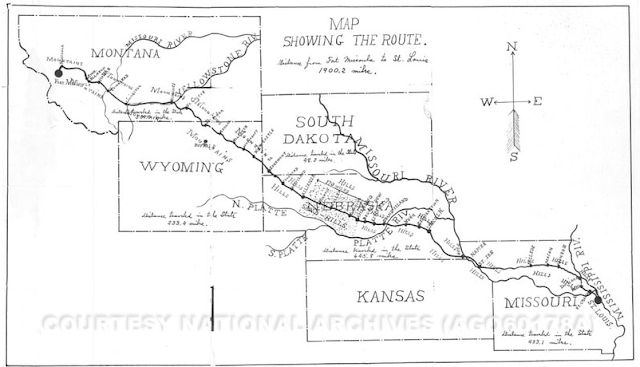
the 25th Infantry Bicycle Corps, America’s short-lived Army squad on bikes, formed in 1896 to test the combat viability of bicycle-mounted troops by riding from Missoula, Montana to Saint Louis, Missouri. Thank you Billy O !

This group of soldiers was the 25th Infantry Bicycle Corps, and they were on their way to St. Louis, MO. Known as the “Buffalo Soldiers,” the 25th Infantry was a regiment of soldiers comprised entirely African descendants, created shortly after the Civil War.
By the early 1900s, the 25th would have gone on to become somewhat of a legend; in 1888, however, they’d been stationed at the Fort Missoula to keep them out of the way. So had their leader, Lieutenant James A. Moss. The Louisiana native had finished bottom of his class at West Point a few years earlier, and considering the town’s “backwoods” status, the Missoula post was not a prestigious one.
Fortuitously, these two misfit entities would be united by the newest fad in leisure to accomplish something amazing: complete one of the greatest journey’s in U.S. history, and show the world that the bicycle was a machine capable of amazing things.


These posed photos are indicated as before the journey, because the bikes do not have chain guards. During the actual journey, all the photos show the bikes were equipped with chain guards

Spalding provided Lt Moss with 10 bicycles for the initial trial in 1896 and, the following year, for the well-documented 3800 mile trip, Spalding supplied 20 Spalding ‘Specials.’
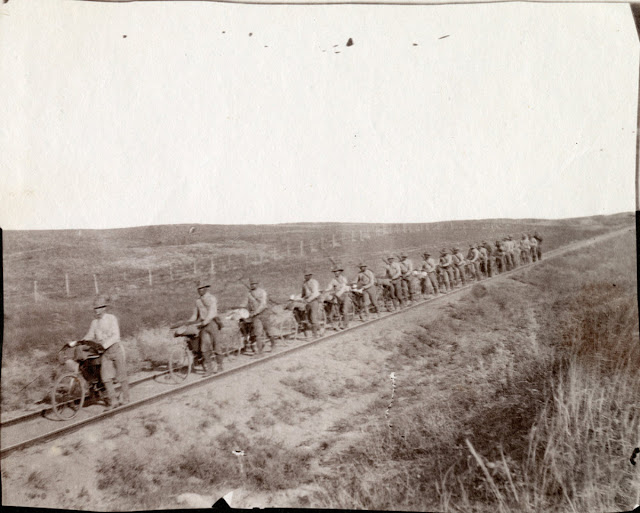
The plan was ambitious, to the point of seeming impossible. It was to ride from Fort Missoula, Montana to Yellowstone National Park and back in 1896 and then with a ride from the fort through the Rocky Mountains, and across the Great Plains to Saint Louis in 1897.

Using handlebar rolls and leather frame bags, the men carried around 55 pounds of gear each aboard their simple 1897 Spalding ‘Special’ Model 922 bicycles, which you can learn more about over at the Online Bicycle Museum.
The bicycles were returned to the Spalding Company, and the soldiers returned to Montana by rail. Soon afterwards the 25th Infantry was deployed to Cuba in the Spanish-American War.
When the Corps reached the Mississippi River, they were met by the Saint Louis Wheelmen, a local bicycle club, and escorted into the city on July 24.

The 25th Infantry and Lt. Moss went on to earn distinction in the Spanish-American War (after a huge send-off from nearly all the citizens of Missoula, for which the 25th had become a point of pride), and when massive wildfires raged across Montana and Idaho in 1910, the 25th was there to help put out the flames. As the superintendent of Glacier National Park put it, “the work performed by them could not be improved upon by any class of men.”


there once was a 3rd https://www.goodreads.com/en/book/show/12429646-fort-missoula-s-military-cyclists

Oh, the history that is ignored by Black History Month blowhards
There are even two books about them that came up on a q1uick google search

Steve told me about the above

this one showed up when looking for that one

there once was a 3rd https://www.goodreads.com/en/book/show/12429646-fort-missoula-s-military-cyclists

Monday, March 21, 2022
the "Television Associates Indiana" had a B 25 for worldwide aerial survey to establish locations for the installation of TV towers and repeaters to extend the range of coverage in the very late 50s

TAI B-25were fitted with long range underwing fuel tanks.
It has been reported that reflecting dishes were extended from their bomb bays.
Back at TAI home base Michigan City in 1958, Greg Board was flying a contract for aerial terrain mapping of Cuba.
Cuba, 1958. That was the last part of the revolution

TAI was bought by Melpar in 1961, Melpar was a subsidary of Westinghouse

by the way, you can read old comic strips and newspapers at https://virginiachronicle.com/?a=d&d=NVS19610825.1.12&e=-------en-20--1--txt-txIN--------
Friday, February 12, 2021

Monday, October 05, 2020
Follow up to the tire recap post... one guy in Florida realized that he had a LOT of scrap rubber, in the middle of a WW2 rubber scarcity, and was GENIUS in his methods of making money from rubber - you're going to love this, and join me in thanking Steve B who finds or KNOWS stuff and shares it with us

After Howard graduated from high school he was sent by his father to study the tire business at the B. F. Goodrich Company in Akron, Ohio.
Frankland came to Tampa in 1925, during the real estate boom, but there were no get-rich-quick schemes for him, he conservatively bought a filling station instead. People would always have to buy gasoline and tires.

He also built a block-long filling station and automobile accessory store on one of Tampa's main thoroughfares, operating both stores with the main office downtown.
On its roof he built a tower, then unheard of, but which has since become a symbol for filling stations. He lighted up the front like a Hollywood premiere.

With the automobile industry taking off, he was doing incredible business, a million dollars a year.
Then he got into fixing tires, and inventing improved tools... then he came up with a way to recycle rubber.

Then things really took off, he recycled rubber scraps into rubber balls, made a factory, patented stuff, and sold the business to AMF Voit.
Rubber was extremely scarce at the time, and recapping tires was the business to be in, and being very wealthy, he joined the city fathers because Tampa Florida at the time needed some leadership and he jumped into road and bridges too, and getting the McDill Air Force Base set up to bring long term military pay into the area.
During the depression which followed the crash, sending the country's financial structure into an upheaval, Howard studied. He learned everything there was to know about rubber.
Howard went to the country's tire manufacturers to learn more about rubber. He was particularly interested in the process of reclaiming rubber. Before the depression was over, General Tires hired him to design and build a pilot plant in Tampa.

So he opened a branch business in Havana--the Servicio de Gomas Pioneer, S.A.
But Cuban bus operators, truck fleet owners and motorists were skeptical and didn't buy. So Frankland bought their old worn out tires, recapped them, and rented them back to the original owners at a cost per kilometer. The Cubans had nothing to lose, so they rented shiny, newly retreaded tires from Señor Frankland
In 1958 the newest product, a unique type of color-flecked floor tile called Tuflex. "Don't worry, it's Tuflex" became the headline in ads placed in sports magazines across the country. This new rubber floor became an instant hit, with brisk sales in country clubs, ice rinks and gyms. The revolutionary flooring bounced back from golf spike traffic while protecting the cleats from wear. Sales quickly expanded with new uses.
You can read a LOT more about it, until you fall asleep with boredom, as someone went nuts on this guy's bio and businesses, encylopedic in fact, as he also got so rich he was running banks. https://www.tampapix.com/frankland.htm
Thursday, July 16, 2020
Broom Vendor's Cart, Havana 1933

https://www.metmuseum.org/art/collection/search/272764
A photo only published in the back of a propaganda book on Cuba, "The Crime Of Cuba" photographed by Walker Evans
http://buttes-chaumont.blogspot.com/2019/02/off-shelf-crime-of-cuba.html
I've never seen a horse drawn cart like this before... 1930s Cuba postcard, and the carriage is singularly Cuban, it's called a Volanta (Thanks Steve! ) and is on their 5 peso coin!

http://buttes-chaumont.blogspot.com/2019/02/postcard-cuba.html
ah hell, now I see that it's labeled right there on the postcard bottom, in red. (Forehead smack)


Monday, March 30, 2020
Diosley Pino grew up in Cuba, moved to the USA, and headed to Santa Paula Ca... and found a 1926 Model T he loved, then made it his daily driver. Original paint and original interior. They seriously built these to last forever... it's a 94 yr old daily driver

that brief title is pretty amazing.... but what it doesn't answer is how he got one of the most prestigious car photographers in the USA, Michael Furman, to photograph it.
You can watch a video past the link, but it doesn't tell you much at all, just that Pino loves his Model T
https://drivetribe.com/p/cuban-style-model-t-OVnU0LVwRaus1sUcNBux6w?iid=RI8fy6YQRlOVv6QCD_aEoA
the only thing I can find out on the internet about this car, or the owner, is that you can rent this Model T for $450 a day on Hagerty Drive Share https://www.driveshare.com/car/4528/search/?l=Los%20Angeles,%20CA,%20USA&mk=&md=&p1=0&p2=4000&ta=1&tm=1&s=recommended&i=97&v=list
and he has a body shop
Sunday, June 09, 2019
In 2003 the US Coast Guard came across a homemade amphibious truck from Cuba halfway to Florida. A car dealership was so impressed they made this replica

the story with this truck is that the original was made in 6 hours. I seriously doubt the welding could be accomplished in 6 hours, or the design and parts list.

It spent 31 hours going 8 mph at sea before the US Coast Guard intercepted it
A Chevrolet dealer in Miami decided to create a replica to honor the incredible crossing made, as they happened to hire one of the guys from Cuba that helped make it... and when he didn't make it all the way to America with it, he didn't give up, and made the voyage in a 59 Buick that he similarly converted to float and power a propeller.


A similar truck was donated to the cause, and about $100,000 was spent to create an accurate replica. It spent some time at Maroone Chevrolet of Miami before being put on display at the Orlando Auto Museum.


the driveshaft is connected to the propeller directly


http://fortune.com/2015/09/10/cuban-migrants-us/
https://www.motorious.com/articles/news/348745/the-cuban-mobile-is-one-of-the-most-ambitious-trucks-in-history
https://www.motorious.com/articles
http://www.floatingcubans.com/
Monday, June 03, 2019

discovered in Cuba in 1996, the next 20 years were spent restoring this gullwing that was first bought and raced by the Cuban Minister of Public Works in the 1958 Cuban Grand Prix.

When the new government was established, Arroyo, who had also been the Cuban ambassador to the United States just a year earlier, moved off the island and settled in Washington D.C., selling the Benz to a Cuban race team in the process.
it passed through a couple owners who neglected it terribly, leaving it out in the rain and sun, and hurricanes, until thieves and rust had a bit of progress into making it far less than feasible to restore.
Then an Italian businessman discovered it, and spent 20 total years forcing the sale from an who owner didn’t even want to entertain the thought of selling.
Four years passed between first contact and refusal to sell, and then reconsidering, and agreeing to let the Italian buy a 50% stake in the car as a first step toward letting him own the whole shebang.
Another six years of negotiation followed, and when the handover was finally completed in 2006, it took six months to remove the various pieces of the car from their various resting places, and 10 years to ship them to Italy from Cuba
The overall restoration, including a full nut-and-bolt mechanical rebuild, took two years.
https://petrolicious.com/articles/it-raced-and-then-almost-rotted-away-in-cuba-until-a-22-year-long-process-brought-this-gullwing-back-to-life?mc_cid=c5202783a7&mc_eid=420b584ab9
Monday, March 25, 2019


Tuesday, March 19, 2019

Wednesday, July 26, 2017
Friday, December 02, 2016
The restoration of Hemmingway's Chrysler 392 hemi New Yorker deluxe convertible in Cuba
Soul, now a dual citizen, USA and England, is a Hemingway fan who has traveled to Cuba several times and is friends with the museum's administrators. When the restoration project stalled, the result of difficulty obtaining parts due to the longstanding U.S. trade embargo with Cuba, the museum director, Ada Rosa Rosales, called on Soul to intervene.
Although Cuban mechanics are experts at keeping old American cars running, much of their work comes down to improvising repairs and hand-making parts. But proper restorations require original components, impossible to find on the island. Soul contacted a parts supplier in Massachusetts that specializes in classic Chryslers and found that its proprietor is also a Hemingway enthusiast. Parts problem seemingly solved.
However, despite Soul's best efforts, some parts have been delayed due to customs snags, while others, like a fuel tank, have proven difficult to locate. The plan had been to debut the hour-long film this June in time for the 14th Hemingway Colloquium in Havana, but the delays will result in a later release.
https://www.edmunds.com/car-news/new-documentary-focuses-on-tale-of-hemingways-1955-chrysler-new-yorker.html
Although Cuban mechanics are experts at keeping old American cars running, much of their work comes down to improvising repairs and hand-making parts. But proper restorations require original components, impossible to find on the island. Soul contacted a parts supplier in Massachusetts that specializes in classic Chryslers and found that its proprietor is also a Hemingway enthusiast. Parts problem seemingly solved.
However, despite Soul's best efforts, some parts have been delayed due to customs snags, while others, like a fuel tank, have proven difficult to locate. The plan had been to debut the hour-long film this June in time for the 14th Hemingway Colloquium in Havana, but the delays will result in a later release.
https://www.edmunds.com/car-news/new-documentary-focuses-on-tale-of-hemingways-1955-chrysler-new-yorker.html
Stats on Cuban cars
From 1950-1958 the number of cars in Cuba more than doubled – from 70,000 to 167,000.
Contrast that with 2014, the first year Cuban policy removed limits on auto purchases resulted in the 11 national Cuban car dealerships selling only 50 cars and four motorcycles in the first half of the year under the new law.
http://www.highsnobiety.com/2016/12/01/cuban-cars/
Contrast that with 2014, the first year Cuban policy removed limits on auto purchases resulted in the 11 national Cuban car dealerships selling only 50 cars and four motorcycles in the first half of the year under the new law.
http://www.highsnobiety.com/2016/12/01/cuban-cars/
Sunday, October 16, 2016

Sunday, October 09, 2016
Cuba's Car Culture, book review

Tom Cotter (author of the barn find books Cobra In A Barn, etc) and Bill Warner (founder of the Amelia Island Concours) have made the most complete book on Cuba's pre-Castro car and racing history and today's current problematic economic and automotive situation, that we are likely to ever need. Seriously, I think this covers the topic, the problem, it's cause and effect so thoroughly, that I doubt another ever needs to be printed.

By the numbers,
188 pages
12 chapters
and normally I count the photos, but this is a photo heavy book... not a book that is word heavy like so many I've reviewed in the past
The re-establishment of international relations between Cuba and the USA is just getting somewhere, but there isn't yet a way for the cars to get fixed, it seems. The people of Cuba are still unable to afford to replace the 6 decades old cars they've been stuck with since Castro and the revolution led to events that stopped all trade and business between most car producing countries and Cuba. (Germany still could export to Cuba, and dictators love BMWs)
I'm not very informed on the who, and when and why, but a couple years after Castro defeated the dictator Bautista, who took off to the Dominican Republic on New Years 1959 with 500 million dollars worth of gold (the world was still on the gold standard), Castro decided to try for a utopian ideal of communism for the Cuban people where everyone was supported by the government, and received a stipend for income, and there is no car insurance (great idea!).
So, anyway, to get to Cuba, you get a ride from Eastern Airlines... yes, they did go bankrupt 25 years ago, but it was bought up by the Havana Airlines CEO, and now, bingo, they are in business to get tourists to spend money in Cuba.
Cuba, is only known for 4 things; cigars, the cars, and the embargo that seemed to never end between 2 countries only 90 miles apart, and the Russian nuke missiles that were heading to a new home in Cuba when they nearly caused WW3.
Well, the missiles were never delivered, the embargo is nearly ended, and the cigars were never stopped from getting into anyones hands that wanted them, and now... the cars. They aren't changed a bit from decades of desperate repairs to keep them on running.
A lot of this book is about how they keep these cars going, replacing all the running gear with Russian car parts. What there is left on the roads of Cuba have had decades more of bad roads than any New York cab, or other steroetypical horrible road vs daily driver. Road repairs in Cuba may have happened since '59, but it seems they have been less maintained than any other, and they weren't much to begin with as the people running Cuba have been the same as any other rulers, greedy and not devoted to the simple duties like keeping the roads fixed.
Then, as the trouble rolled downhill, it ended up settling into the cars, and it spread it's problems through them all. Without replacement parts, they've been making due for about 4 and a half decades. Maybe the Russians reverse engineered some Fords back when (1930s?) but it seems they didn't bother with any in the late 50s, and then provide those parts to the Cuban auto parts stores. That actually would have been ironic, and kinda cool for the car owners of Cuba.
The 5th chapter is the history of cars in Cuba, and it's pretty cool. I didn't know that Cadillacs were sold in higher numbers per capita in Cuba than any other country, including the USA before the embargo.
Chapter 6 is all about racing in Cuba's history, and if you have been interested in the gran prix's and Fangio's kidnapping, you'll enjoy this chapter. Did you know they had stock car racing? And there were Edsels, Studebakers, and Dodges racing in stock, and in the sports car classes were Porsches and Mercedes 300SLs.
But, did you know that the GP races were almost not held in Cuba due to the deaths when the Mercedes went through the grandstands and killed 80 at the 1955 Le Mans? And, of course, something similar happened in Cuba, as the track wasn't anything more than city streets, and the rumor is that the people were not happy with the rich and wealthy racing, and the poor getting poorer due to the Castro regime, so they oiled the track on a fast corner, and a car wiped out and killed 6 and injured 40 more. Bet you never heard about that. But the lack of race organizers, and complete lack of safety, meant that no warning was given to incoming race car drivers.
And the 1960 Cuban GP was missing Briggs Cunningham, becuase the Cubans had seized his business in Cuba, so he boycotted the race - and seriously, would you take part competing in a country that had stolen your property and business?
Chapter 9 is about the celeb cars, like Hemmingway's. Can you believe David Soul (Starsky and Hutch) is funding it's restoration? It still has it's original hemi too.
So enjoy the book! You'll get fully informed on Cuba's Car Culture. It's far more in depth than I thought it would be, and terrifically full of photos of the cars and Havana.

Subscribe to:
Posts (Atom)