Showing posts with label Desoto. Show all posts
Friday, December 13, 2024
Sunday, November 17, 2024
Friday, August 16, 2024
Monday, January 29, 2024
This photo is an exploded view of an actual B-29, showing many of the main components, and the companies that made each, is new info to me!
The Chrysler DeSoto nose section is separated from the Goodyear built bomb bay fuselage sections.
The Hudson built rear fuselage sections with the Goodyear vertical and horizontal tail and control surfaces can be seen.
The main wing center section was built by Martin Omaha but the outer wing section components built by Hudson are visible.
The Fisher Body engine nacelles have Chrysler built engine cowlings attached. Frigidaire props are off the Dodge built engines.
Saturday, November 11, 2023
Tuesday, October 24, 2023
Saturday, October 21, 2023
Wednesday, September 20, 2023
Groucho Marx's family got two DeSotos a year, for him performing as spokesman and doing commercials
In fact they'd been keeping eyes and ears open for likely prospects and what impressed John Guedel about Groucho was his ability to ad lib, or "wing it" on the spot as he'd done on the Bob Hope All Star radio special broadcast in April, 1947.
Once Guedel convinced Groucho to step on board, he got the campaign rolling to do this game show with improvisation as part of the dialog. Groucho was going to be the host. Contestants everywhere were in for a shock. You Bet Your Life debuted on ABC live October, 27,1947.
It did rather well. By 1949, the show switched over to CBS broadcasting. One more network hop happened during the wireless era. a move to NBC radio during 1950. In fact, NBC decided to run it as a television show as well that year. Big changes were in the offing, including a prominent sponsorship deal by DeSoto Automobiles.
DeSoto-Plymouth Motors joined sponsorship on January 4th, 1950. Ratings were very solid and they were entering the big league ratings wars. A rumor started by Bernie Smith who worked for Batten Barton Durstine and Osborn ad agency in Detroit claimed that one of the top executives from CBS went to see the President of DeSoto Motors and offered a million dollars if DeSoto Motors convinced the principals of You Bet Your Life show to run the television show with CBS.
At the time, the principals decided to put it up for bidding since the contract with Elgin-American had expired. DeSoto did wind up being the new sponsor for 1950 and NBC wound up being the new network with the hottest show. They needed it to because CBS had raided their talent cabinet in 1949!
As part of DeSoto's promotional tie in with the show, Groucho Marx and family were given two DeSoto vehicles per year. Groucho used this perk thoroughly and enjoyed it very much. An interesting development in this deal is the fact that one of those cool cars wound up in Europe during a tour he did in 1953. Groucho picked up his DeSoto sedan in London for driving through Europe. Groucho and friends visited Paris, toured through France and into Germany, making a special visit to Dornum, his Mother's birh place. He also visited Italy. The DeSoto remained in Europe after Groucho's tour. The DeSoto sponsorship era lasted until 1958.
Sunday, February 12, 2023
Friday, November 25, 2022
one of the BEST Halloween movies, my favorite, the Franc Capra directed 1944 film "Arsenic and Old Lace" with Cary Grant, Peter Lorre, and 1936 DeSoto Airflow taxis, is finally on the Criterion Collection Blu Ray
At that time the Police Department of the five boroughs of New York City mandated that taxicab operators use purpose-built vehicles that allowed five adults to travel comfortably in the rear compartment.
DeSoto’s recently introduced 7-passenger S-1 Airstream sedan could be easily modified to meet the City’s ‘five-in-the-rear’ requirement and Waters submitted a prototype to the New York City Hack Bureau for approval.
Only two manufacturers, Checker and General Motors, were producing purpose-built cabs that met New York City’s requirements and Chrysler was interested in breaking in to the market. As Chicago and Los Angeles fleet operators generally used the same equipment as their Manhattan brethren, the potential profits for all involved were immense.
As Plymouth-DeSoto’s largest distributor, Waters was able to make a deal with Chrysler whereby he would convert stripped 7-passenger DeSotos into taxicabs at a metro Detroit factory, then offer them to taxicab fleet operators through his Plymouth-DeSoto dealerships.
If successful, the scheme would provide Chrysler with a share of the taxicab market without any risk or capital outlay, additionally Waters could offer the vehicles with a full Chrysler Corp. warranty. The original agreement involved taxicabs specifically built and designed for Manhattan’s Sunshine Radio Service.
On June 19, 1936 the first shipment of 200 Waters-DeSoto taxicabs paraded down Broadway to a special ceremony welcoming the Sunshine Radio System to Manhattan.
The welcome was short-lived as a month later the Mayor, LaGuardia, threatened to bring about the revocation of the licenses of the Sunshine Radio Systems’ taxicab fleet unless there was a “noticeable reduction” in the din of their horns over the coming week-end.
The Mayor was well-known for his intolerance of urban noise and as a result of his complaints a city magistrate set about determining exactly how loud a taxicab horn should be the following Monday.
In an ironic twist, Waters delivered 550 new DeSoto Sky-View taxicabs to the Terminal Taxi Corporation, a firm founded by General Motors a decade earlier to try and put Morris Markin’s Checker Cab Mfg Co. out of business. The last General Motors long wheelbase five-in-the-rear taxicab was built in 1937, so when Terminal needed to replace its aging GM cabs DeSoto was an easier pill to take.
Terminal declared bankruptcy in the late thirties and its assets were purchased by Chicago native Daniel G. Arnstein, a friend and former employee of John D. Hertz. Prior to the start of World War II, Arnstein was sent to China by President Roosevelt to help straighten out the transportation nightmare popularly known as the Burma Road.
Another major Waters’ client was W. Lansing Rothschild, the owner of Los Angeles and San Francisco’s Yellow Cab Co. Rothschild had purchased some of Waters’ 1936 DeSoto taxicabs, and remained a good customer into the early 1950s.
Mr. Waters moved spectacularly in the automobile business in which he started as a small dealer in used cars after World War I. He rapidly amassed wealth and became the world's largest distributor of DeSoto and Plymouth cars.
Only two manufacturers, Checker and General Motors, were producing purpose-built cabs that met New York City’s requirements and Chrysler was interested in breaking in to the market. As Chicago and Los Angeles fleet operators generally used the same equipment as their Manhattan brethren, the potential profits for all involved were immense.
As Plymouth-DeSoto’s largest distributor, Waters was able to make a deal with Chrysler whereby he would convert stripped 7-passenger DeSotos into taxicabs at a metro Detroit factory, then offer them to taxicab fleet operators through his Plymouth-DeSoto dealerships.
If successful, the scheme would provide Chrysler with a share of the taxicab market without any risk or capital outlay, additionally Waters could offer the vehicles with a full Chrysler Corp. warranty. The original agreement involved taxicabs specifically built and designed for Manhattan’s Sunshine Radio Service.
On June 19, 1936 the first shipment of 200 Waters-DeSoto taxicabs paraded down Broadway to a special ceremony welcoming the Sunshine Radio System to Manhattan.
The welcome was short-lived as a month later the Mayor, LaGuardia, threatened to bring about the revocation of the licenses of the Sunshine Radio Systems’ taxicab fleet unless there was a “noticeable reduction” in the din of their horns over the coming week-end.
The Mayor was well-known for his intolerance of urban noise and as a result of his complaints a city magistrate set about determining exactly how loud a taxicab horn should be the following Monday.
In an ironic twist, Waters delivered 550 new DeSoto Sky-View taxicabs to the Terminal Taxi Corporation, a firm founded by General Motors a decade earlier to try and put Morris Markin’s Checker Cab Mfg Co. out of business. The last General Motors long wheelbase five-in-the-rear taxicab was built in 1937, so when Terminal needed to replace its aging GM cabs DeSoto was an easier pill to take.
Terminal declared bankruptcy in the late thirties and its assets were purchased by Chicago native Daniel G. Arnstein, a friend and former employee of John D. Hertz. Prior to the start of World War II, Arnstein was sent to China by President Roosevelt to help straighten out the transportation nightmare popularly known as the Burma Road.
Another major Waters’ client was W. Lansing Rothschild, the owner of Los Angeles and San Francisco’s Yellow Cab Co. Rothschild had purchased some of Waters’ 1936 DeSoto taxicabs, and remained a good customer into the early 1950s.
Mr. Waters moved spectacularly in the automobile business in which he started as a small dealer in used cars after World War I. He rapidly amassed wealth and became the world's largest distributor of DeSoto and Plymouth cars.
The executive was a veteran of WW1 serving as an Army Air Corps instructor. He came to San Francisco to sell airplanes but soon turned to the automobile business and, in 1929, became Chrysler's Northern California distributor for De Soto.
His rise to the top was an outstanding chapter in the nation's success stories. When others succumbed to the '29 crash, he went on and four years later bought the San Francisco building in which he started business. Original cost of the building was $1,250,000.
A year after he started selling cars on Long Island, he sold $3,500,000 worth of cabs to a Manhattan concern and set up his own assembly plant in Detroit.
If the golden era of salesmen ended with the '29 crash, nobody told Waters about it. His fortunes rose as the business curve went down. By 1933 he had enough money to buy the San Francisco office building (original cost: $1,250,000) in which he started his business. Last year he branched into selling De Sotos on Long Island, upped his sales to about 4% of De Soto's entire output. Meanwhile he had tackled the taxi business.
Of all branches of the automobile industry, manufacture and sale of taxicabs is the hardest to make a go of. General Motors tried it for a while (through its subsidiary Yellow Truck & Coach), found that it had to operate taxis to be sure of a market in Manhattan, finally began withdrawing in 1934 after it had to repossess two big fleets at a loss of $1,000,000. Next year it sold its Manhattan operating company (Terminal) at another $733,000 loss. Soon Checker Cab Manufacturing Co. was left the only important manufacturer in the field. But even Checker, with a virtual monopoly on production, had dizzy ups & downs.
To Supersalesman Waters, the taxicab business looked as easy as anything else. After selling an occasional taxicab on the side, he jumped in with both feet in 1936, landed a $3,500,000 order for 2,500 cabs from a new operating system (Sunshine) organized in Manhattan that year. To manufacture them, he contracted with De Soto for chassis and body parts, set up his own assembly plant in Detroit. His De Soto SkyView cab now roams Manhattan streets about 7,000 strong.
Waters had a theory that his predecessors in cab manufacturing got into trouble by operating their own fleets; he lets some body else worry about running his cabs, is happy to sell one to anybody who has $295 for a down payment. Manhattan's independent cabbies swear by him; until he started selling them brand-new cabs at $1,195 they had to pay nearly that much for castoffs from the big fleets.
http://www.coachbuilt.com/bui/w/waters/waters.htm
To Supersalesman Waters, the taxicab business looked as easy as anything else. After selling an occasional taxicab on the side, he jumped in with both feet in 1936, landed a $3,500,000 order for 2,500 cabs from a new operating system (Sunshine) organized in Manhattan that year. To manufacture them, he contracted with De Soto for chassis and body parts, set up his own assembly plant in Detroit. His De Soto SkyView cab now roams Manhattan streets about 7,000 strong.
Waters had a theory that his predecessors in cab manufacturing got into trouble by operating their own fleets; he lets some body else worry about running his cabs, is happy to sell one to anybody who has $295 for a down payment. Manhattan's independent cabbies swear by him; until he started selling them brand-new cabs at $1,195 they had to pay nearly that much for castoffs from the big fleets.
http://www.coachbuilt.com/bui/w/waters/waters.htm
The law was finally changed and in July of 1954 the previous 5-passenger standard was eliminated and standard four-door Detroit-made sedans became eligible for taxi cab service in Manhattan. The long-wheelbase cars that were previously embraced, were now outlawed as a new maximum wheelbase of 120” was implemented. Although all involved denied it, lobbyists for Ford and General Motors were likely behind the new regulation as they were tired of being shut out of the lucrative Manhattan market.
Friday, September 23, 2022
Gary Kuchar's collection is coming to the Van Der Brink auction, and he had a hell of a wide variety of cars in his collection
that Mustang above the windshield? NOPE. This collection was picked over before the left overs were listed for auction. Most of them don't run, and you will see a Bobcat moving them for photos. But then, at these prices, you're paying for the rust free bodies, not running cars.
DeSoto Airflow
no info on the engine
has a 400 cu in. So, wtf is that doing in there? But it's a Phoenix, and those are cool
401 AMX Javelin
see the Bobcat? And this seems to be the only Mustang getting sold
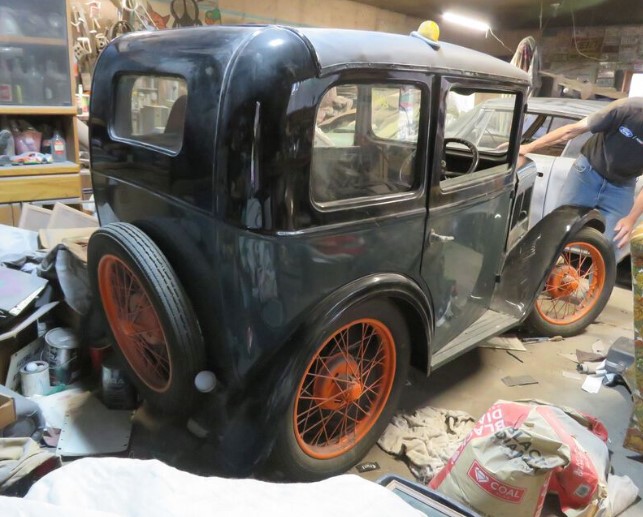
Damn. I wish I could afford to buy this Bantam. I'd be so damn happy.
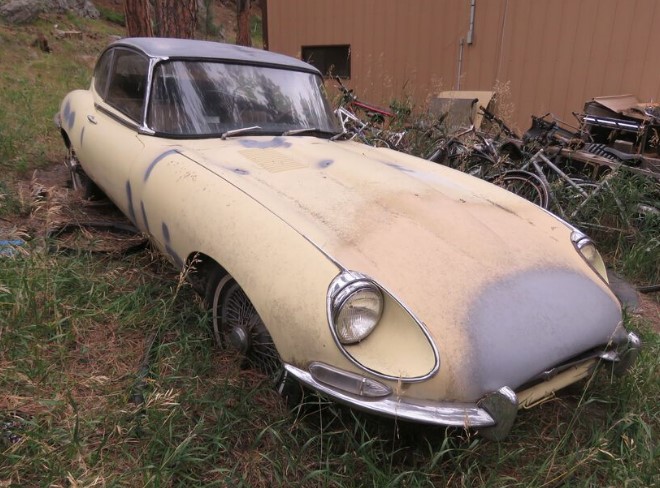
but someone that has always wanted an E Type Jag is going home thrilled!
there's a bunch of other cars, and trucks, and Scouts, etc etc
Sunday, May 08, 2022
I could spend hours in this farm's abandoned car area just taking patina photos
See what I mean? Anyway, these are all screen grabs from a video, which is in this post at the end
the narrator and his friends are so annoying I recommend that you turn the sound all the way off. Trust me. You don't want to hear him for the 100th time say how he knows nothing about cars, or "look at this" for the thousandth time. Put some music on you like, instead
Subscribe to:
Posts (Atom)