Showing posts with label auto-gyro. Show all posts

Friday, February 24, 2023

John Miller flew the first commercially available autogyro cross-country from the Hudson River in NY to San Diego, CA


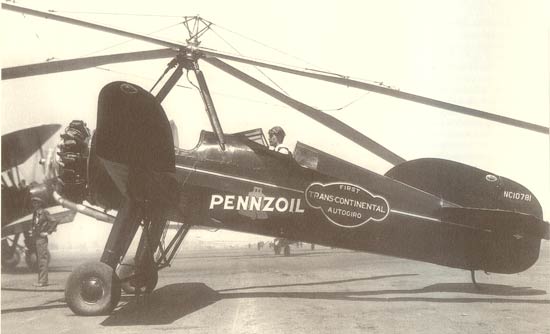
Miller, by 1931 with a mechanical engineering education at Pratt Institute of Technology, Class of 1927, and seven years of flying experience, had become the first individual to purchase a PCA-2 for a cash price of the then sizable $15,000 plus "a little extra for an auxiliary fuel tanks and emergency flare racks for night flying."24 Upon ordering he had been informed that he would receive production model C/n B-12 in April 1931, by which it was anticipated the ATC would be granted (it was on April 2, 1931), a delivery date later postponed to May. At the time of his order, C/n 13 was in the production line, but no order had yet been received.25 Upon receiving confirmation of his PCA-2 order, Miller immediately began planning a transcontinental trip,26 a daring undertaking as no one had previously attempted such a long flight.27 It should be remembered that there were no established radio communication or navigation aides, neither established routes or traffic control and little available weather information other than often inadequate and infrequent advisories for a few frequent areas. That data which pilots now take for granted, weather fronts, air mass, wind conditions, route charts – all were in the future. Miller and other pilots flew with dated Rand McNally state maps and, if lucky, a few "strip" charts printed by the Army Air Service between their fields. And to top it off, Miller had to avoid rain as it would quickly imperil his life in cutting through the rotor blade fabric. This flight was to be in conjunction with a series of exhibition flights – and he kept sales and production officials, including Edwin T. Asplundh, fully informed of the flight plans.

Miller was understandably surprised when, in early May, he read in the New York Times of Beech-Nut’s intent to sponsor Amelia Earhart’s transcontinental flight! Flying to the Pitcairn Willow Grove field, he quickly discovered that the company had inserted Beech-Nut’s order ahead of his and that he was now to receive C/n B-13 (NC10781). This was clearly an attempt by the company to facilitate Earhart’s flight as the Beech-Nut order had been placed after Miller’s, and he later claimed that "the mechanics and the test pilots leaked the information to me that the sales manager had decided that he would rather have Earhart make the first transcontinental flight for better publicity coverage."28 Miller knew that he was merely regarded as an "unknown professional pilot without such publicity as Beech-Nut could provide" and also learned from the Pitcairn company pilots that Earhart’s final check ride was being delayed until her aircraft could be finished. Miller also later claimed that he spoke with Earhart several times while at the Pitcairn factory and that "she told them that she was not interested in all the aerodynamics and short landing procedures" but "she just wanted to fly it across the continent and then fly around the country for a Beech-Nut advertising campaign."29 So Miller resorted to subterfuge in the face of the company manipulation and announced that "if Amelia wants to make the flight she is welcome to it" but that he had to be in Omaha for the Air Races by May 17 or he would suffer a financial loss. He took a room at a local nearby tourist home and while waiting to take delivery of his Autogiro, received a check ride in the experimental PCA-1B, known as the "Black Maria" (X96N),30 by factory test pilot ‘Skip’ Lukens. Lukens took Miller on a single checkout ride, as he had previously done with Earhart, with five checkout practice landings – after that, Miller was given use of the Black Maria for practice during May 9 – 12, 1931 – he made 110 practice landings with a total of 5.5 hours of flying logged. This averaged out to flights of about 3 minutes along with practice in low cloud banks with the turn indicator. Finally, on May 14, 1931, he took delivery of his Autogiro, which he would name, presumably after the David Ingalls article31 in the March 31, 1931 issue of Fortune Magazine, the "Missing Link.". After five short test hops, Miller promptly left and headed west in PCA-2 NC10781.32

Miller was an experienced professional and aerobatic pilot and had gained extensive knowledge of the aerodynamics of the Autogiro from conversations with pilots Jim Ray, Skip Lukens, Jim Faulkner, and Pitcairn chief engineer Agnew Larsen. He would need all of his abilities for the trip west. While the normal cruising speed of the "Missing Link" was 100 mph, Miller flew at 90 mph to conserve fuel and break in the new engine. The Wright R-975-E, 330 hp, air-cooled radial engine consumed 18 gallons/hour, so Miller could only fly for three hours at which point he would only have 15 minutes of flying time on his fuel reserve. Navigation was by magnetic compass, following landmarks such as rivers or roads, and the pilot hoped that when a landing had to be made, there would be an airfield where the Rand McNally road maps showed one – it was not always the case. Miller discovered this at the end of the second day, during which he flew from Harrisburg to Chicago. He had flown seven hops, 11.3 hours over a route he had never flown before, aiming to land at Maywood Air Mail Field – but that airfield had been abandoned, and its replacement, later known as Midway Airport, was not yet finished or marked on the maps. Miller arrived at the site of the older field after dark and, after a perfect landing, located the new field, to which he immediately flew as he would have to refuel before continuing on. He napped on a workbench and, after refueling, left for Omaha at first light. He hadn’t even eaten. He then flew an additional seven hops, 7.2 hours flying and, after arriving at the site of the Omaha Air Races, flew an additional two hours and made 14 demonstration flights after arrival.

Miller remained in Omaha from May 16th until the 19th, and then left for San Diego. Headwinds kept him from reaching Clovis, NM on May 26th so he landed en route and installed extra fuel tanks on the front seat during the night. The next day he reached the NM town but encountered strong headwinds on the way to El Paso, which consumed extra fuel forcing him to land 18 miles short of his destination to add fuel. On May 28th he began the last leg of the journey from Lordsburg, NM before first light and, after flying 4 hops for 8.9 hours, landed at North Island Naval Air Station, San Diego, CA. The first Autogiro transcontinental flight had taken a total flying time of 43.8 hours and was without mechanical incident. The aircraft had performed flawlessly with the most difficult task for Miller seemingly to get used to the shadows of the blades passing over his head, and the severe sunburn he incurred.

NC10780 was sold to George Palmer Putnam, husband of Amelia Earhart, of New York, NY in May 1931, he sold it to Beech-Nut Packing Company two months later, Earhart continued to fly it for company promotions, when they sponsored Earhart’s early flights


Among other products, the Beech-Nut company manufactured Beech-Nut chewing gum, which was supplied in bulk to Earhart for distribution to the crowds who gathered to witness her cross country landings. (Charter member of 99's) https://iwasm.omeka.net/items/show/1297

 It was painted green (the cream panel remained), with “BEECH-NUT” painted large upon its flanks.


The Kansas native with a penchant for “first-time things” and a love of “shining adventure,” as she called it, flew an autogiro across the country in June 1931, stopping at Cheyenne, Laramie, Parco (present Sinclair), Rock Springs and Le Roy, Wyo., west of Fort Bridger.

 Earhart wanted to set a transcontinental record in the awkward-looking craft, which resembled a fixed-wing propeller plane with an engine on the front, but was equipped also with four long rotor blades that spun at 100 revolutions per minute –much slower than the 400 revolutions per minute of modern light helicopters—above the open cockpit. 

The 52-gallon fuel capacity of the rotorcraft, dubbed the “flying windmill” by the press, made frequent stops necessary. Amelia made time to visit with local dignitaries and give flight demonstrations. She charmed the crowds who greeted her on the ground.

On the tour, she stopped in 76 towns during about three weeks of traveling. She flew an average speed of 80 mph, about five hours daily, often landing 10 times in a day. She became the first pilot to fly an autogiro round-trip across the United States.


She bought a canary-colored Kissel Kar automobile, which she named Yellow Peril, and made a 7,000-mile cross-country trek with her mother, Amy Otis Earhart, visiting several national parks en route.

in 1932 Capt. Lewis Yancey piloted a Pitcairn Autogiro, christened Miss Champion for the spark plug company, from Miami to Havana at the start of a Yucatan archeological expedition.


The year before, he flew it all over America

Champion Spark Plugs bought it to advertise the spark plug company, like a flying billboard, across 21 states, flying 6500 miles, visiting 38 cities with the 1931 Ford National Air Tour

During January 1932, having flown south to avoid the northern winters, Captain Yancey took “Miss Champion” from Miami to Havana, Cuba, where it arrived amidst fanfare and the usual press interest. From there, he flew onward to Mexico’s Yucatan Peninsula where he used the unique slow flight characteristics of the autogyro to participate in an archaeological exploration of the Mayan pyramids and ruins.


 It proved very effective in this role, spanning many miles of jungle and finding sites that would have been missed by ground search teams. It was a dream opportunity for the Champion Spark Plug Company, which garnered wide attention from its sponsorship of the archaeological research and came away with some absolutely stunning publicity photos.

After the Yucatan expedition, it was retired

It's one of 2 PCA-2 Pitcairn's that survive today in museums


Yancey had earned fame on a South America circumnavigation publicity tour of "Pilot Radio" in 1930, when Pilot Radio Company of Brooklyn sent their experimental aircraft radio plane, a “flying laboratory,” on a “good will flight” through Latin America, primarily to publicize their products.

Their subsequent marathon journey around the perimeter of most of the South American continent would be filled with challenges for the radio equipment, the plane, and, most of all, for the men. Traversing oceans, mountains, desert, and jungles, they would set new records for long-distance air-to-ground communications, broadcast to the people of Buenos Aires from the air, meet with U.S. ambassadors, heads of state, and indigenous Amazon natives; they would be briefly imprisoned, search for a lost flier, and visit exotic and unique places. 

Along with Yancey, was Zeh Bouck, who visited the White House in 1930 and met with President Hoover, and used this expedition to represent the Hoover administration, acting as an unofficial U.S. ambassador to South and Central American nations.

He was one of the first radio columnists, writing for the New York Sun by 1922, and a newsmaker himself. He wrote hundreds of articles for magazines ranging from Boys’ Life to Radio News to Cosmopolitan.

They staked their lives on a plane that developed mechanical problems and could not land on water on a route with few landing areas. How they survived the journey and the true story of what happened during the flight are told for the first time staring on page 95 of https://www.antiquewireless.org/wp-content/uploads/2020-AWA-Review-Vol-33_compressed.pdf


It was the first successful aircraft flight to Bermuda from the United States, and in April, 1930. The plane was a Stinson SM-1FS "Detroiter", Pilot Radio. It ended up crashed and left there.

Why is the flight significant to Bermuda?

The twenties and thirties had great competition for records to be broken in every venue (flagpole sitting for example). One record that had been pursued but failed with cost of lives was the first Great American Journey, a dream of flight to Bermuda from the North American mainland. 

It was long before the capabilities of sending a radio beacon beam to an aircraft to utilize safe navigation. The Bermuda Trade Development Board earlier offered a 25 thousand dollar prize for the first flight to Bermuda. No airport existed in Bermuda, thus a float plane would be necessary.

Wednesday, August 16, 2017

Saturday, August 25, 2012

the "Pep Boys Snowman" autogyro (Thank you Colby!)

 boxes of Tydol either getting loaded or unloaded... in the snow beside the landing strip... which made me realize that an autogyro has a shorter landing and takeoff distance than a similar size airplane, making it better for landing in showy areas

found on http://yuripasholok.livejournal.com

Update Feb 2023:
Colby just commented and filled me in on what this photo is about!

This was a prototype autogyro that was brought by Admiral Byrd during the second Antarctic Expedition. 
The tower in the background was a wind turbine used to generate electricity for the base, Little America II. 
The front of the plane had a decal on the door that read Byrd Antarctic Expedition II, but the shadow makes it unreadable in this picture. It broke down and had to be left in Antarctica. 
 Source: Great Granddad went on the expedition and has a collection of slides that includes this autogyro

Thank you Colby! 


https://aviation.stackexchange.com/questions/84027/can-anyone-identify-this-autogyro

Monday, June 07, 2010

cool things found at Greyhandgang.com

What do you think, an airport runway snow melter?

Buckminster Fuller and a Dymaxion
Cuban taxi's.... aren't they awesome! Looks like a 55 Ford and a 53 Chev. I'd take a ride in these over a modern taxi, damn right I would

I'm not sure, but it looks like the trans-arctic vehicle

A street car used to build artificial reefs

The Vereycken Diwheel 1947 and you can read more about it http://douglas-self.com/MUSEUM/TRANSPORT/diwheel/diwheel.htm

The Munsters coach it looks like, it is on Santa Monica Blvd, and it's 1964

An Autogyro over New York

a photo of the Blitzen Benz I haven't seen before
looks like El Mirage

What an Americana moment, the purple car is a Studebaker Commander I think

Friday, February 12, 2010

Auto-gyro, or gyro copter

top photo from http://megamoto.tumblr.com/
Above: Amelia Earheart and an Autogyro close up


the propeller pulls it through the air, the helicopter blades weren't powered and started spinning as the plane acquired forward momentum, and provided lift... notice that there aren't wings on the planes in the top and bottom photos. .

a helicopter works by forcing the rotor blades through the air, pushing air downwards, the autogyro rotor blade generates lift in the same way as a glider's wing by changing the angle of the air as it moves upwards and backwards relative to the rotor blade. The free-spinning blades turn by autorotation; the rotor blades are angled so that they not only give lift, but the angle of the blades causes the lift to accelerate the blades' rotation rate, until the rotor turns at a stable speed with the drag and thrust forces in balance. http://en.wikipedia.org/wiki/Autogyro