In the 1920s and 1930s the “must have” souvenirs weren’t created to be collected at all. National Park Service windshield stickers served a practical administrative purpose; they were evidence that the automobile license fees due at some parks had been paid. Americans embraced the stickers' colorful, artistic designs, sparking a collecting craze. Drivers pasted so many to their windshields they quickly became a safety hazard.
Architect Robert Reamer, who designed the Old Faithful Inn dining room and Bear Pit Bar at age 29, hired Chicago artist Walter Oehrle (pronounced "early") to come up with a series of sketches that would later be turned into wood carvings.
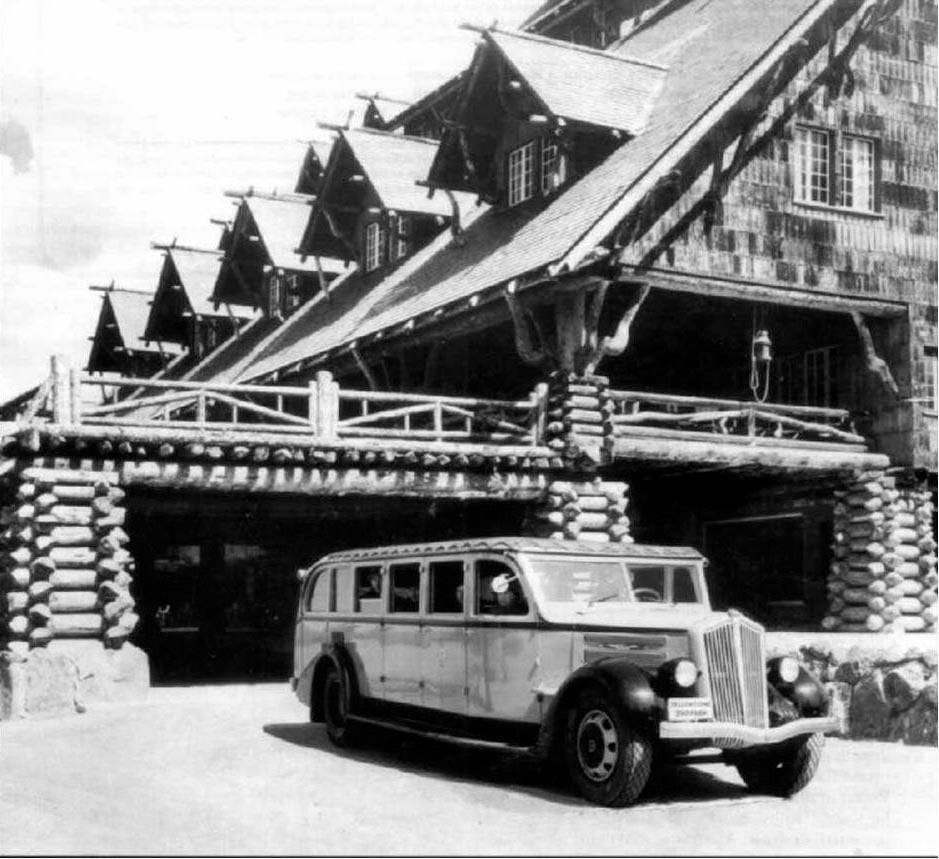
the Old Faithful Inn
The inn's architect was 29-year-old Robert Reamer, an architect for the Yellowstone Park Company, which was affiliated with the Great Northern Railway. Reamer was hired by Harry W. Child, the president of the Yellowstone Park Company, who had met Reamer in San Diego through mutual acquaintances. Reamer designed the lobby and the initial phase of guest rooms, known as the Old House, which was built in 1903-1904,
The Old Faithful Inn is the largest log hotel in the world; possibly even the largest log building in the world, and located in Yellowstone National Park, with a clear view of the renowned Old Faithful Geyser.
The Inn features a multi-story log lobby, flanked by long frame wings containing guest rooms. With its spectacular log and limb lobby and 500-ton, 85- foot stone fireplace, the inn is a prime example of the "Golden Age" of rustic resort architecture, a style which is also known as National Park Service Rustic.
It is also unique in that it is one of the few log hotels still standing in the United States. It was the first of the great park lodges of the American west. Initial construction was carried out over the winter of 1903-1904, largely using locally-obtained materials including lodgepole pine and rhyolite stone.
An oil furnace exploded in the blacksmith shop located in Yellowstone Park Transportation Company’s repair and maintenance building in March of 1925
The explosion quickly scattered burning fragments all over the shop. Fanned by a strong wind from the south, the fire spread quickly and completely destroyed a large number of park vehicles and the garage in which they were housed as well as machine, paint and top shops, all were destroyed within an hour.
This group of soldiers was the 25th Infantry Bicycle Corps, and they were on their way to St. Louis, MO. Known as the “Buffalo Soldiers,” the 25th Infantry was a regiment of soldiers comprised entirely African descendants, created shortly after the Civil War.
By the early 1900s, the 25th would have gone on to become somewhat of a legend; in 1888, however, they’d been stationed at the Fort Missoula to keep them out of the way. So had their leader, Lieutenant James A. Moss. The Louisiana native had finished bottom of his class at West Point a few years earlier, and considering the town’s “backwoods” status, the Missoula post was not a prestigious one.
Fortuitously, these two misfit entities would be united by the newest fad in leisure to accomplish something amazing: complete one of the greatest journey’s in U.S. history, and show the world that the bicycle was a machine capable of amazing things.
These posed photos are indicated as before the journey, because the bikes do not have chain guards. During the actual journey, all the photos show the bikes were equipped with chain guards
There was one problem. The Corps had 20 men but zero bicycles and zero funding to buy any. To overcome this, Lt. Moss struck a deal with the Spalding Bicycle Company—donate bikes to the expedition, and Spalding could use the Corp in their advertisements, and would be first in line to supply the military if the idea proved fruitful.
Spalding provided Lt Moss with 10 bicycles for the initial trial in 1896 and, the following year, for the well-documented 3800 mile trip, Spalding supplied 20 Spalding ‘Specials.’
The plan was ambitious, to the point of seeming impossible. It was to ride from Fort Missoula, Montana to Yellowstone National Park and back in 1896 and then with a ride from the fort through the Rocky Mountains, and across the Great Plains to Saint Louis in 1897.
Using handlebar rolls and leather frame bags, the men carried around 55 pounds of gear each aboard their simple 1897 Spalding ‘Special’ Model 922 bicycles, which you can learn more about over at the Online Bicycle Museum.
When the Corps reached the Mississippi River, they were met by the Saint Louis Wheelmen, a local bicycle club, and escorted into the city on July 24.
The bicycles were returned to the Spalding Company, and the soldiers returned to Montana by rail. Soon afterwards the 25th Infantry was deployed to Cuba in the Spanish-American War.
The 25th Infantry and Lt. Moss went on to earn distinction in the Spanish-American War (after a huge send-off from nearly all the citizens of Missoula, for which the 25th had become a point of pride), and when massive wildfires raged across Montana and Idaho in 1910, the 25th was there to help put out the flames. As the superintendent of Glacier National Park put it, “the work performed by them could not be improved upon by any class of men.”

Barnes and Gray mixed local dirt and water into Adobe bricks to build their adobe art gallery called “Sierraden” (building still located just east of Sierra Lodge on Highway 198).
Born in 1906, in Des Moines Iowa, Carroll Barnes studied at Washington DC's Corcoran School of Art, he then studied with Carl Milles in the Cranbrook Academy of Art in Bloomfield Hills Michigan
Barnes was the subject of the 1972 documentary Man, the Artist and Nature, he died in 1997
Barnes, who had once worked as a lumber-jack, settled into a studio near Sequoia National Forest in 1941, Barnes embarked on a 16 ½-foot-tall version of Paul Bunyan, a project which, interrupted by service in the Army, preoccupied him for seven years. Carved from a 2,000-year-old Sequoia tree, (over the actual time of 18 months) the mammoth statue gained distinction as the world’s largest wood carving and earned Barnes a legendary status among sculptors.
His skills earned him a position as a professor of art at the
University of Texas
Three Rivers is near Visalia Ca, just South of Fresno