Showing posts with label Marmon Wasp. Show all posts

Monday, November 14, 2016

the Marmon Wasp was in the shell booth at SEMA, on loan from the


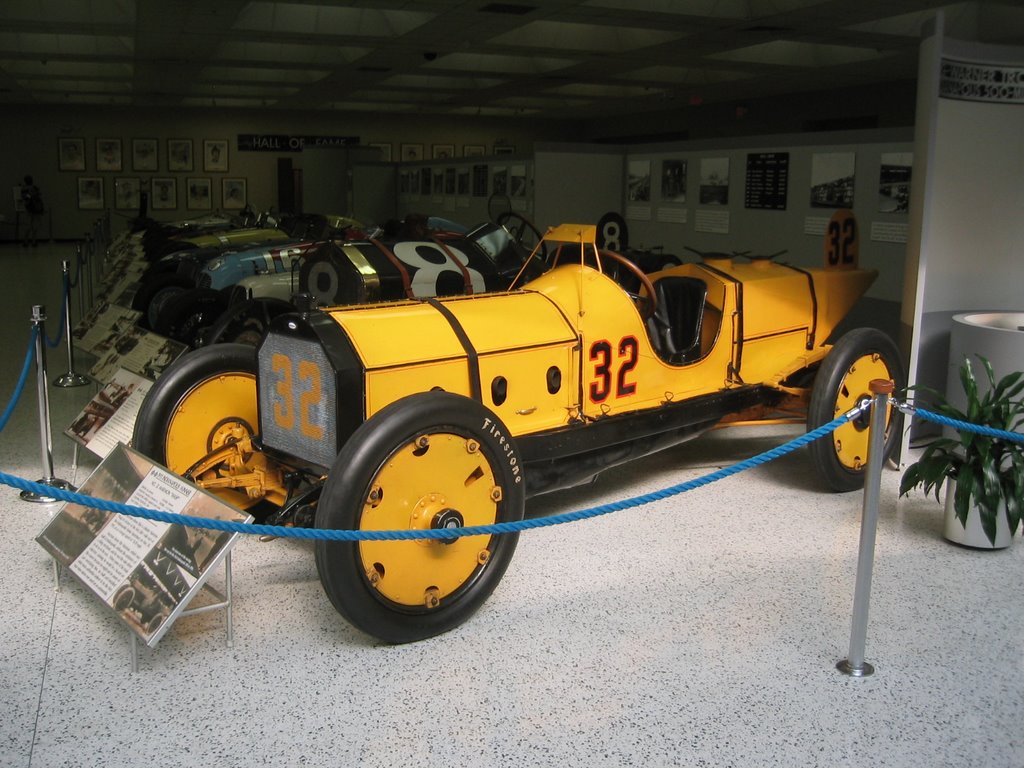
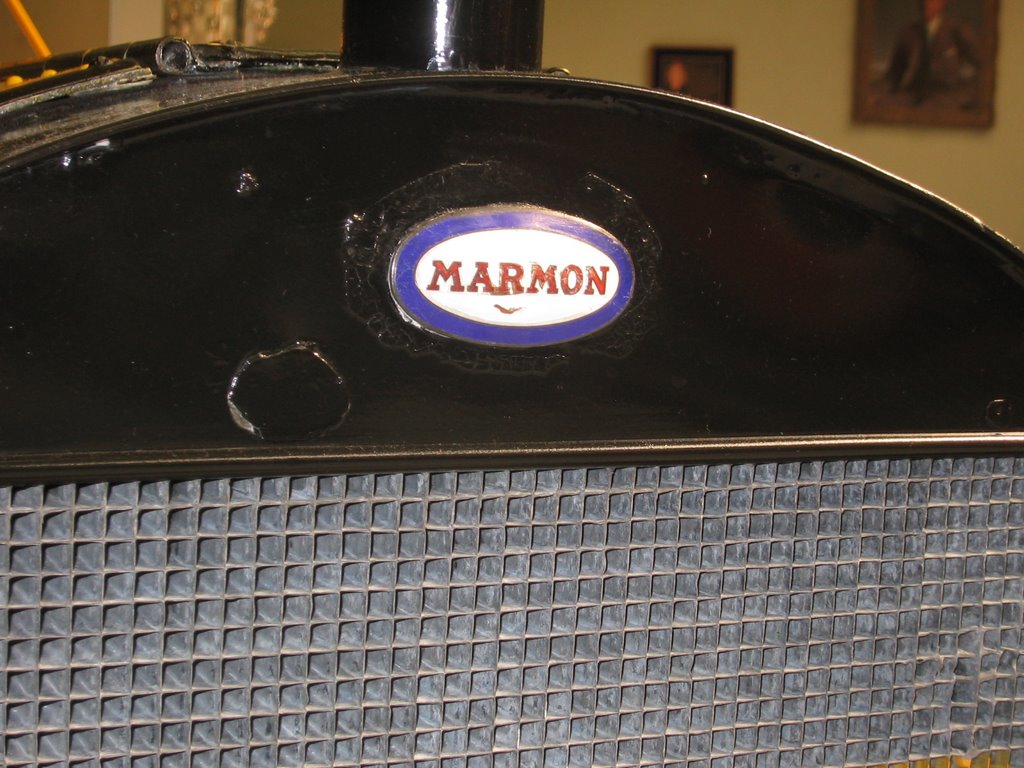
The Marmon Wasp was raced at the 1911 Indianapolis 500 by Ray Harroun who along with Howard Marmon designed the car. It was the 1st single seat open wheel race car.

A study of innovation from nose to tail. Up front the Wasp used a four shock system to counteract the bumpy conditions of the dirt and gravel surfaces and unpredictability of the new brick surface at Indy. Harroun, the consummate engineer, determined that speeds over 80 mph were disastrous for tires so he kept his speed in check and only changed two tires during the race. The second place car by contrast changed tires fourteen times during the race.

 The engine had two more cylinders than the four used in the Marmon 32 Model which was already quite successful in racing.

 The cockpit was designed only for the driver which shaved significant weight off the car with a narrower body and one less passenger (the typical mechanic) aboard.

 To accommodate the steering position a gear system was devised to move the steering column to the center of the cockpit. The tail was also unusual in the style of an airplane tail and stabilizer.

 Perhaps the cleverest feature was the rear view mirror he installed before the race to address the fear that his driving solo would endanger other racers because he would be without a mechanician on look out.

 Years later Harroun said that the mirror was unfortunately useless during the race because it shook too much.
https://www.historicvehicle.org/marmon-wasp-first-indy-500-winner-opens-2016-sema-show/


Saturday, June 04, 2016

the Stinger, a new homage to the Marmon Wasp Indy 500 winning race car, sold for $900,000 to an investment group


In May 2011, the Indianapolis Motor Speedway celebrated its 100th anniversary, marking a full century since the 1911 Marmon Wasp won the inaugural Indianapolis 500. To pay homage to that legendary machine, the Window World company commissioned the construction of The Stinger, in an effort to commemorate the centennial era of the Indianapolis Motor Speedway and the Indianapolis 500, they made a modern-day interpretation of the history-making Marmon Wasp.

The car was built for the centennial and since then, Indy racer John Andretti has been taking the car around the country to get it autographed by every living Indy veteran.

The aerodynamics of The Stinger are state-of-the-art, packaged with a Honda-donated, race-winning engine. The Stinger’s yellow and black color scheme honors its namesake, as a tribute to history. And with the support of Indianapolis 500 legends, The Stinger is now a part of that history.

Though the centennial of that race was held five years ago, the race this year will be the 100th running of the event, which was not held during war years.


With a collection of signatures from nearly 250 of the 273 total Indianapolis 500 Veterans as of 2011, The Stinger has become a priceless salute to a century of excellence.

John Andretti not only had to hunt down the drivers, he had to take the car to nursing homes for some to sign, to one ailing driver’s driveway. Another was in jail and signed while wearing shackles. “It’s been a real adventure,” Andretti said.

Andretti, a nephew of Mario Andretti and cousin of Michael Andretti and Marco Andretti, traveled tens of thousands of miles with the Stinger to find autographs. Most of the missing signatures belong to retired racers who live overseas, and Andretti wasn’t willing to send parts of the car abroad for signatures.

In addition to its Indycar body and chassis, the Stinger carries a race-winning Honda engine and wears Firestone tires embedded with the names of every driver who has the 500 on that brand of tires. The seat in the car came out of a car raced by four-time IndyCar series champion Scott Dixon.


All of the proceeds from the auction went to St. Jude Children’s Research Hospital in Memphis.

http://www.windowworldcares.com/the-stinger/
https://news.classiccars.com/barrett-jackson-help-celebrate-indy-500-centennial-special-auction/

Wednesday, December 02, 2009

Marmon Herrington since 1851: 4 wheel drive and beyond, makers of busses, tanks, and the Rhino... never heard of the Rhino?


above image found on http://bangshift.com/blog/bangshift-trivia-do-you-know-what-the-hell-this-is-we-do.html


For the best write up and photo gallery see the Popular Science October 1954 pages 125, 126 and 127 ... Since none of us have that issue, go right here for Google (thanks Google!) who has a library scanning project underway: http://books.google.com/books?id=GCEDAAAAMBAJ&pg=RA2-PA26&lpg=RA2-PA26&dq=Marmon-Herrington+rhino&source=bl&ots=cPP0J40U4f&sig=PhUp8XzQuE3aQ0Rg6AKZX9FcKs0&hl=en&ei=27UWS8qDLM7jnAfKovHOBg&sa=X&oi=book_result&ct=result&resnum=9&ved=0CCgQ6AEwCA#v=onepage&q=Marmon-Herrington%20rhino&f=false


Better and different footage was filmed by Movietone, and can be seen here: http://www.itnsource.com/shotlist//BHC_FoxMovietone/2009/11/03/X03110902/

The Rhino was invented by E. Aghnides, naturalized American frem Greece, and he made a lot of money by his inventions and had Marmon Harrington build the Rhino... it took them 5 years. The front wheels weigh 1500 pounds each and are 6 feet tall, and are hollow rubber clad in aluminum. The hemisherical shape of the tires has a fascinating integral property... the deeper they sink into sand or mud, the more weight bearing surface they provide in contact, and the more traction they then have.

The Rhino could barely be tipped over as the side angle it would remain stable at went to 75 degrees, and could assail a 65 percent grade... it had 12 mpg, was watertight, and was propelled in water by a directional nozzel, was made of Aluminum, and was rear wheel steered

It was featured in issue #16 of Wheels and Tracks, and that can be ordered from Capricorn books at http://www.antiqbook.com/books/bookinfo.phtml?nr=1204493643&Language=en for about 10 dollars

For all about the tank part of MH: http://www.overvalwagen.com/tanks.html

Marmon might be a familiar name, I just recently posted about the Marmon Wasp, 1st winner of the Indy 500 http://justacarguy.blogspot.com/2009/08/winner-of-first-indianapolis-500-race.html

A leader and innovator in design, engineering, and manufacturing since 1851, Marmon Herrington made a variety of 4 x 4 and 6 x 6 vehicles for the US and Persian armies used as general load carriers, mobile machine shops, wreckers and balloon winch trucks. Reconaissance, scout and armored cars were also made, some with 4-wheel-steering as well as 4­wheel-drive.

In 1932 Marmon-Herrington built the first all-wheel-drive truck and trailer combination for oil pipe construction in Iraq. Also in 1932 there was a very special project, a 40-passenger articulated coach ordered by the Nairn Brothers for the Damascus to Baghdad desert run. The 6 x 6 tractor was powered by a 90 hp 6-cylinder diesel engine and fitted with a sleeper cab. This was coupled to a luxurious tandem-axle coach 66 feet long, the combination weight being 30 tons. Air springs were added to the tractor's front. semi-elliptic springs. This freighter-bus was still in service during World War II, now operated by the Royal Air Force.


The tractor trailers they made are prized by truckers, and were made from 1969 to 1988 in Garland Texas... for a great article read: http://www.etrucker.com/apps/news/article.asp?id=60955 the 2nd story

Saturday, August 01, 2009

Winner of first Indianapolis 500 Race, it was lighter, more reliable than the competition... and had one thing they didn't. Rear view mirror.

thanks Steve!


found on https://www.facebook.com/indianaracingmemorialassociation?fref=nf

For a 2009 replica of the Wasp; http://justacarguy.blogspot.com/2009/11/marmon-wasp-indy-500-replica.html


This Marmon Wasp won the first Indianapolis 500 Race in 1911... at that time, all race cars held two men, a driver and a co-driver/mechanic.

The Marmon was a single seater, unlike every other car on the track which had a seat for a driver and riding mechanic.

Marmon figured that shaving the weight of the mechanic from the car reduced the weight making it faster around the track and streamlined the car. It was widely speculated the car won because of its lighter weight.

Officials wanted drivers to have a riding mechanic so they could have an extra set of eyes on the track to avoid collisions. To skirt this rule, a mirror was hastily fixed to the hood and track officials were told that the driver could now see behind him, negating the need for a co-driver with a second set of eyes.

But the mirror vibrated so much, it was useless

This was the first rear view mirror ever used on a race car (or a passenger car as well). The driver, Harroun, was an Indiana native and still holds one Indy 500 record. No one has ever come from the 28th (or worse) starting position to end up winning the race.

Between the years of 1903 and 1933 Marmon Motor Cars, made approximately 250,000 cars. Fewer than 350 exist today.

If you’d like to help support the ongoing preservation of automotive history like Ray Harroun’s Marmon “Wasp” and many others like it, contact Greta Allen at the Museum at (317) 492-6779 to reserve your Hall of Fame Museum license plate, or check out this link for more information: IMS Hall of Fame Museum License Plate