
Showing posts with label mission symbols. Show all posts
Showing posts with label mission symbols. Show all posts
Tuesday, April 07, 2026

Monday, December 08, 2025

Saturday, December 06, 2025
An innovative way to display mission markers on a WW2 bomber, "punching a ticket" on the Tough Shit, with an outhouse tent between the T and the S, and the mission markers were "punched out" around the perimeter

42-64051, "T.S.", with the blue reconnaissance camouflage paint half removed, late May or early June 1944, at Nadzab, New Guinea, then Biak Island in this time frame.

The nose art was applied at Hickam Field, Hawaii while the repair of leaking fuel tanks delayed the trip to New Guinea

20th Photographic Mapping Squadron Long range aerial mapping and reconnaissance using F-7A and F-7B aircraft (B-24's converted for aerial photography) Radar intelligence gathering with B-24J ferrets


modern versions of nose art, with Star Wars characters some just new versions of WW2 Disney military insignia / patches - and with cool mission symbols on the scoreboard, by Phil Postma


I just posted the original of this last week, the submarine USS Baya, SS 318 https://justacarguy.blogspot.com/2025/11/very-unusual-and-out-of-ordinary-disney.html

Friday, October 03, 2025

Sunday, February 23, 2025

Sunday, June 16, 2024
Milk Wagon, 129 missions, no problems, great mission symbols!

It set a record for a Fortress in the 447th Bomb Group, as she racked up no fewer than 129 missions without suffering a single abort due to mechanical issues, a testament not only to the strength of the B-17, but also to the ground crews who kept her in the air.


Wednesday, April 17, 2024
the P 47 Rae caught my attention for it's ASTONISHING billboard, and mission symbols, but then... I see it's pilot had the same name as my maternal grandfather, H Shook! (this post motivated by all the wonderful readers who boosted my spirits today and got me posting instead of glumly applying to jobs)

He had a childhood dream of flying, and on his 21st birthday, he entered flight training for the Army Air Corp. He graduated just days after Pearl Harbor and remained in the states as an instructor pilot, further sharpening his flying skills.
He was a career Air Force pilot and commander. As the D-Day invasion neared, he was offered a squadron commander position and promoted to major while still only 23 years of age.
He participated in three different combat theatres including leading a squadron of P-47's for 3 missions during the D-Day invasion and 3 more the following day.
He finished his USAF career leading an Air Division during the Vietnam War.


this is the best version of the billboard I can find

Sunday, October 15, 2023

Nemesis of Aeroembolism, a test B17 used to do the research on high altitude operations, once with a "para-pooch" dog named major, who static line dropped from 26000 feet, doing the doggy paddle all the way down

The Boeing Test engineers possibly painted this special medical nose art for Aero Medical Laboratory staff at Wright Field, Dayton, Ohio, in 1943. The dark haired lady “Aeroembolism” [wearing a gold bikini] has been twined by two gold snakes as she stands on her tip-toes over the badge of the Air Forces Material Command at Wright Field, Ohio.
It is believed the nose art was painted at the Boeing Test Laboratory just before the aircraft was flown to Material Command, Wright Field, Dayton, Ohio, on her second tour of High Altitude flights in September 1943.

Notice the dog in the crew photo, that's Major.
The “Strato-Gremlin” was painted on the nose after each high altitude [40,000 ft. or more] flight. It is believed the same fuselage art of the Strato-Gremlin was painted on 41-2407, however, no photo proof can be found.
First assigned to Material Command, Wright Field, Ohio, where high altitude testing began 1 November 1942. This Boeing aircraft conducted high altitude parachute drops and almost killed Dr. Randolph Lovelace in June 1942, when he jumped from 40,200 feet.
They used rubber dummies for most test drops, then in April 1944, purchased a 145 lb. St. Bernard dog from the Dayton, Ohio, dog pound for $3.
Poor old “Major” was pushed out at 26,000 feet [wearing his custom oxygen mask] and survived his first test drop, measuring the parachute straps opening shock effects.
First assigned to Material Command, Wright Field, Ohio, where high altitude testing began 1 November 1942. This Boeing aircraft conducted high altitude parachute drops and almost killed Dr. Randolph Lovelace in June 1942, when he jumped from 40,200 feet.
They used rubber dummies for most test drops, then in April 1944, purchased a 145 lb. St. Bernard dog from the Dayton, Ohio, dog pound for $3.
Poor old “Major” was pushed out at 26,000 feet [wearing his custom oxygen mask] and survived his first test drop, measuring the parachute straps opening shock effects.
“Major” the Saint Bernard that would parachute out of an adapted B-17G. The images (from upper left and moving clockwise): adapted B-17G airplane used for the research; custom insignia on the nose of the B-17G; “Major” in his flight suit; custom dog-faced oxygen mask; key moments in the descent where there are great forces exerted on the body; graph showing the opening shock pressure as recorded by the tensiometer.

the mission symbol is the Strato Gremlin

Aviation Gremlins are defined as “Mythical elves, upon whom military pilots are said to blame all their troubles and sometimes their good luck.”
Reference to the mischievous Gremlin first appears in the Royal Air Force (RAF) in 1929; however, by World War 2 (1939-1945), the science of “Gremlinology” was firmly entrenched in RAF lore. By 1941, the first Gremlin sightings were reported at airfields in America and onboard warplanes of the U. S. Army Air Forces (USAAF).
One of the most cantankerous, altitudinous Jinxes was the Strato-Gremlin who menaced the big Boeing B-17 Flying Fortress and its aircrew. Strato-Gremlins were rarely encountered below 35,000 feet and were thought to be responsible for all aero medical and mechanical problems airmen encountered in the stratosphere.
Case in point. Every time the USAAF’s flying research laboratory, Boeing B-17E #13 (ser. no. 41-2407)—a.k.a. The Nemesis of Aeroembolism—passed through 40,000 feet, the Nemesis often developed an oil leak in one of its turbo-supercharged radial engines, or a case of the “bends” in one of its flight crew.
These problems were suspected to be the work of Strato-Gremlins because shortly after landing at Boeing Field or Wright Field, another Strato-Gremlin appeared painted on the ship’s starboard bow!Coincidence? The aviation physiologists thought not!
To educate aviators of the dangers of the pesky Aviation Gremlins, the USAAF prepared field guides to identify the different members of the Gremlin family.
The most dangerous aero medical gremlin, of course, was the beautiful Gremlin Annwho left men gasping for breath the higher they ascended. She “loved great big strong men who don’t need to use their oxygen equipment.” Once reaching the substratosphere, Ann knocks ya (anoxia!) for a loop and then turned loose her four stooges to make airmen suffer more, including Cockeyed Charlie, Stuttering Sam, Blind-as-a-Bat Bill, and Droop the Dope.
At altitudes above 25,000 feet, the high-altitude gal, Bubbles Nitrogen(Fig.1), full of sparkling vivacity and nitrogen, cuddled airmen and gave them bubbles in their blood, after which Rheumatic Rheuben attacked the men's joints with his ax to produce the pains known as “flier’s bends”. Additionally, big, strong Choking Choseph (Fig. 2) hugged airmen full of Bubbles N2 with his huge arms and gave them the “chokes”. The Rebreather Bag Boys were always trying to cut off an aviator’s oxygen supply at altitude due to a detached oxygen hose or by poor care of the pilot’s oxygen equipment. Likewise, Wet Oxygen Willie, froze oxygen regulators and tubing at high altitudes. Perhaps the most obnoxious gremlin was Windy, a most unsocial gremlin who forced airmen to choose a meal of beans, cabbage, and hot dogs before a high-altitude mission. Then, after reaching 38,000 feet and the gases in their intestines had expand 5-fold, he’d give them the works!
And, of course, on long missions, Joe Flight Gremlin whacked airmen’s muscles and joints with his spiked club making them achy and sore. There also was the Icy Gremlin,the Blackout Gremlin, the Spandules, and so many more…too many to list here.
As Dr. Major Randy Lovelace of the Wright Field Aero Medical Lab often mused: “Gremlins are to aviators what children are to your home. They’re brats but you love them… What would man’s ambition be without his children? What would aviation be without its Gremlins?”
The Boeing Experimental [Flight Test] organization was involved with developing, proving, and test flying the next production B-17 model, which included high altitude flights. At least four different test Boeing models were assigned to high altitude testing in 1941, beginning with B-17C, serial 40-2042. [No known nose art] Accepted Boeing Field 21 July 1940, Wright Field, Dayton, Ohio, December 1940 to August 1941. Crashed New Albany, OH, 25 January 1943, killing seven.
The seventh production B-17E, serial 41-2399, was assigned as a test model, November 1941, fitted with a new B-17F nose and a modified smaller rudder for higher altitude test flights.
This aircraft conducted extended high altitude flights at Boeing Field, Seattle, and Wright Field, Dayton, Ohio. After each test flight [0ver 40,000 ft.] a small “Strato-Gremlin” was painted on the nose, just like a bomb painted for WWII combat missions.

It is possible this original aircraft art was created at Boeing Field in Seattle, however, this has never been confirmed and might remain in Boeing WWII files today.
https://clarencesimonsen745590793.wordpress.com/2023/03/27/boeing-test-nose-art-polar-bears-bugs-billy-goats-babes-and-bad-gremlins-pdf-version/
Tuesday, July 18, 2023
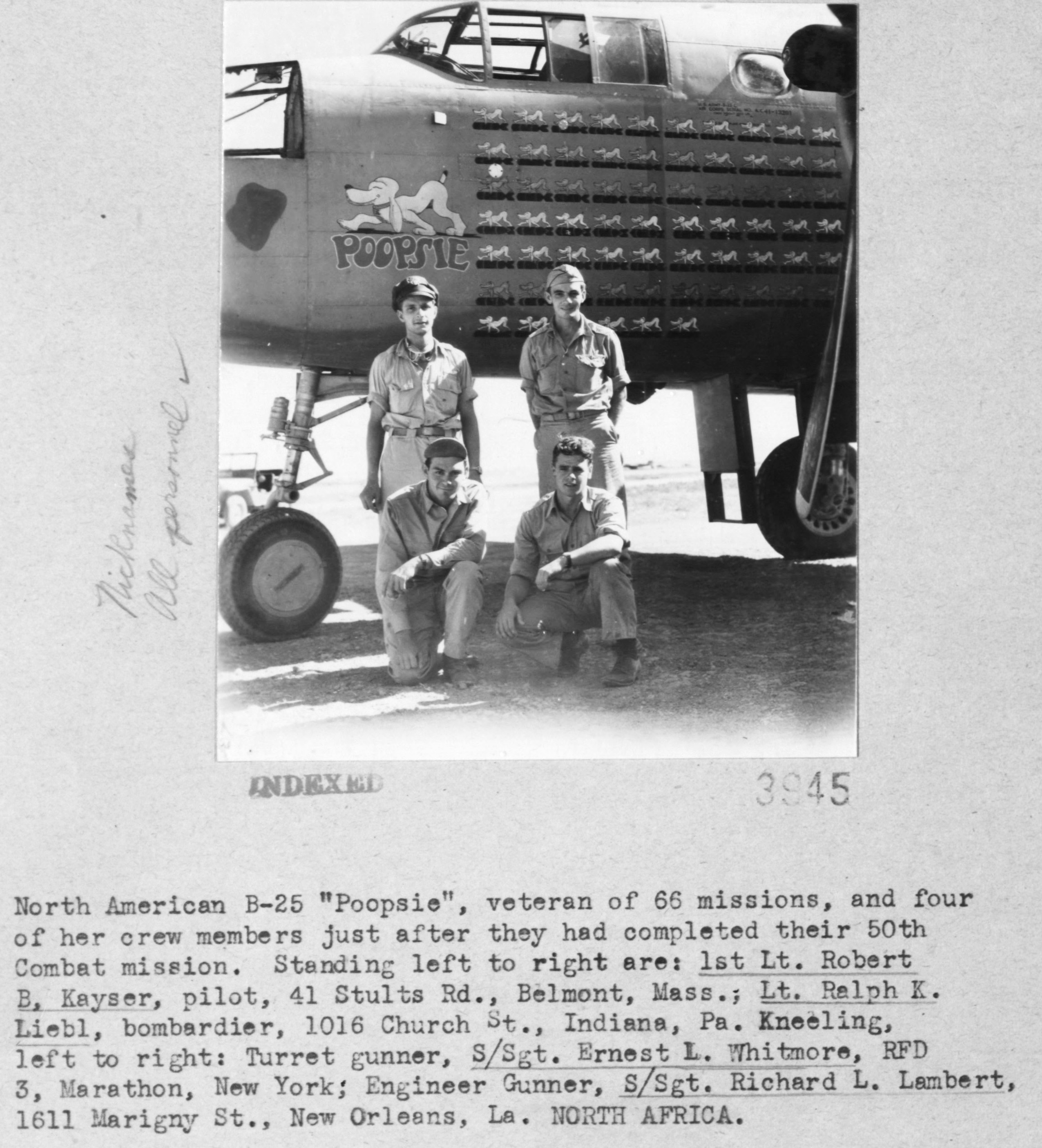
unique scoreboard mission symbols. Poopsie completed 66 missions


It's still on display, after returning to the states after the war, and serving as a corporate plane for National Metals, and Filmways Inc, and taking part in the 1968 movie Catch 22
Sunday, September 11, 2022
100 mission symbols, 5 Japanese fighter kills, one battleship kill, 4 cruiser kills, six merchant ship kills and two smaller craft. This was T/Sgt James W. Cannon’s record in the Pacific Theatre of Operations, before he was assigned to the 8th AF in the ETO !

Technical Sergeant James W Cannon at only 21 years old, had an incredible record:
He has flown 68 operational missions in the South Pacific in B-25s, B-26s, B-17s and B-29s, and B-17s in the ETO.
Confirmed credit for the destruction of five Jap Zeros. (this technically makes him an Ace)
He took part on the Battle of the Bismark Sea when his aircraft skip-bombed at 30 feet over the water and sank a Jap heavy cruiser.
He wears the Silver Star, DFC with two Oak Leaf clusters, Air Medal with eight clusters, Purple Heart, Asiatic-South Pacific ribbon with two bronze stars, ETO ribbon with two stars, Presidential Citation Award with two clusters and the American Defense and Good Conduct ribbons.”
Thursday, October 21, 2021
Thursday, July 16, 2020


Friday, October 04, 2019
respectable scoreboards

this is P 47 pilot Ed Fisher in 1944, https://justacarguy.blogspot.com/2019/08/whoa-look-at-that-scoreboard-p-47-pilot.html


notice that this guy is the same guy painting on different planes

a BRIDGE?!!?!


http://www.axis-and-allies-paintworks.com/e107_plugins/forum/forum_viewtopic.php?430
Subscribe to:
Posts (Atom)