Showing posts with label street cars. Show all posts

Tuesday, March 24, 2026

Atlanta’s streetcars were one of the slowest forms of public transportation available, and, probably the most expensive to the taxpayer, per rider. (thank you LukyPunchy!)


The system has an average traveling speed of 5 mph. Considering the average human walking speed is 2.5 to 4 mph,

The cost of the first 2.7 miles exceeded estimates at $99 million, or $36.7 million a mile, in 2015. In 2023, estimated costs ballooned to between $88 million to $107.5 million a mile for the proposed expansion with total project costs ranging from $176 million to $230 million

Considering MARTA has had a 60% reduction in ridership in the last decade, it's fair to point out that buses are much less expensive, the streetcar was free, but ridership was significantly below capacity, and now that the line costs $1 a ride, ridership has sunk to an average of 400 riders a day in 2022, so the busses capacity of 50 to 60 passengers? Easily would handle all the riders there are in a couple of slow commutes, and bus use can be easily scaled up or down with changing passenger demand.

Monday, March 23, 2026

The DC streetcar's final week of service is upon us. The boondoggle will offer its final ride on March 31.


it was born in a 2002 feasibility study, promised as a 33-mile network, delivered as 2.2 miles on H street with no fare collection, and is being replaced by a bus that does the same thing but can turn. $200 million well spent.


The streetcar repeatedly failed to live up to its promises. 

Initial planning began in the 1990s. The city published a feasibility study in 2002 and broke ground in 2004. 

Three streetcars were ordered from a Czech company in 2005 but sat in European storage until 2009 because the city didn’t know what to do with them.

In 2011, the District’s Department of Transportation announced the H Street Line would open in 2013. Beset by delays, the 2.2 miles of track finally opened in 2016.

It was comically over budget. Construction cost about $200 million. Operating the streetcars cost $10 million every year.

Many didn’t dare ride because of how many homeless people camped out. 

 Finally, a serious structural budget deficit has forced city leaders to pull the plug. Outgoing D.C. Mayor Muriel E. Bowser (D) says “next generation” electric bus service will replace the streetcars by mid-2029. In the meantime, the chair of the D.C. Council’s transportation committee announced plans to budget $250,000 for a study of replacement transit options.

Of the many lessons from this debacle, perhaps none is more important than the fresh reminder of the sunk-cost fallacy. Year after year, D.C. politicians were unwilling to expend the political capital necessary to stop wasting millions of tax dollars, because they were afraid of antagonizing a small but vocal community of die-hard advocates for public transit. It’s better late than never to stop throwing good money after bad, but D.C. could have stopped this streetcar in its tracks two decades ago.


D.C. Department of Transportation (DDOT) Director Sharon Kershbaum noted that six streetcars need to be replaced, which would cost the city $11 million each. In contrast, diesel transit buses cost on average $500,000 and electric buses $750,000. Expanding the streetcar system would set taxpayers back more than $100 million and its fare-free design meant the estimated $200 million lifetime cost of the system would always be subsidized.


Friday, November 21, 2025

the worst streetcar crash in US history was on May 25th, 1950 on 63rd and S State St in Chicago


the Green Hornet Streetcar collided with a gas truck. This was a combination of inattention by the operator, to avoid a flooded underpass the motorman entered the switch at full speed which made the streetcar jump the tracks and hit the truck. 34 people died, and people were left homeless due to buildings burning down.

Thursday, August 31, 2023

they fix old street cars, in Dallas, in a former mattress warehouse, now a restoration and repair shop, where Dallas’s newly acquired historic trolley cars are painstakingly restored and the current fleet is affectionately maintained.


When MATA founder Phil Cobb began revitalizing the city’s trolley system in the late 1980s, he visited a private collection in San Francisco and bought Rosie on the spot.
 Margaret was purchased in the mid-1990s, when a transit system in Toronto planned to scrap it. 
The car known as Betty ran in Dallas in the 1920s, but was eventually sent to the ranch of a Dallas Railway CEO, where his children and grandchildren used it as a playhouse. 

The street cars were cobbled together from various countries and across decades. 

For example, the car known as Emma came to Dallas from Brussels and has a narrower body, better suited for European streets. 
Matilda is much bulkier and ran for six decades in Melbourne, Australia before being shipped to Texas. Rosie was built in Philadelphia in 1909 and then shipped to Portugal, where it ran for 79 years before being bought by a private collector in San Francisco.  

Other than upgrading cars with safety features that include extra brakes, lights, and stop signs, MATA claims each car in the fleet is as close to original as possible.

https://www.atlasobscura.com/articles/dallas-trolley-car-barn

Saturday, June 11, 2022

it came from Blackpool

https://tramsstophere.files.wordpress.com/2011/09/vambac.jpg

interesting museum piece

1967, 6th St. at Susquehanna in Philadelphia

https://www.facebook.com/oldimagesofphiladelphia/photos/pcb.2247315821998010/2247326851996907/

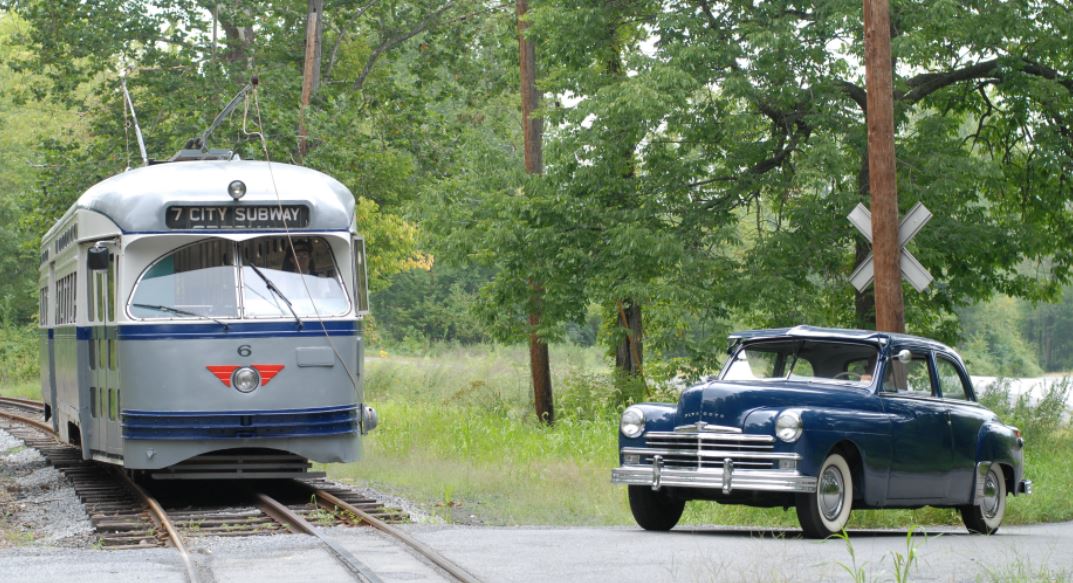
1945 subway car used until the late 1980s, that's been restored and is in the Rockhill Trolley Museum, Pennsylvania was part of a New Jersey city scam, as what else have NJ politicians ever done?


the president of TCRT, as well as another company official and the owner of a local scrap firm all were later convicted in federal court on fraud and associated charges related to the rapid dismantling of the TCRT streetcar system, in order to replace streetcars with buses. 

New management took over TCRT in 1949, and was successful in finding buyers for its virtually new PCCs, selling the cars at bargain prices. 

Mexico City took the lion’s share, while Cleveland’s Shaker Heights Rapid Transit bought 20. Public Service Coordinated Transport, predecessor of New Jersey Transit, bought 30 cars for the Newark City Subway.


a young Swedish sailor jumped ship in New York Harbor in 1918, joined the U.S. Army, fought in Europe during World War I, returned to New Jersey to settle down, and in 1938, managed to purchase a decommissioned trolley for $1, and bought land in an undeveloped town for $14. His great grandkids are THRILLED!


The biggest challenge, of course, was how to transport the trolley to the remote spec of land. Ingenuity prevailed again. For $300, Ed Sr. had the trolley shipped on a flatbed truck.

It took several years for Ed Sr.,  a bus driver and his wife worked for the phone company, and his Scandinavian friends to secure the trolley and build a cottage around it. The Sjonells lived in a two-family home in Elizabeth, and the trolley was their rustic weekend home

Eventually, the trolley structure boasted a kitchen and two bedrooms, all fashioned inside the original passenger car; the living room and front porch were built as add-ons.

Ed Jr says they made the trek to Point Pleasant just about every weekend. “We’d drive down Route 34,” says Sjonell. “Every third or fourth trip, we’d get a flat tire.” The family would stop off at an ice house on their way to the Shore. “We’d get a hunk of ice for a quarter and put it in the icebox on the back porch,” he recalls. “We had a pump for water. We had an outhouse. You could say it was very rustic.”

 Days were spent fishing, crabbing and swimming in the nearby Manasquan River. “We’d go fishing all the time,” says Sjonell. “We caught eels in the bay, and my father would fry them.” Weekends were a special time. Life was carefree; the trolley home sat on what was then a sandy, dead-end street.

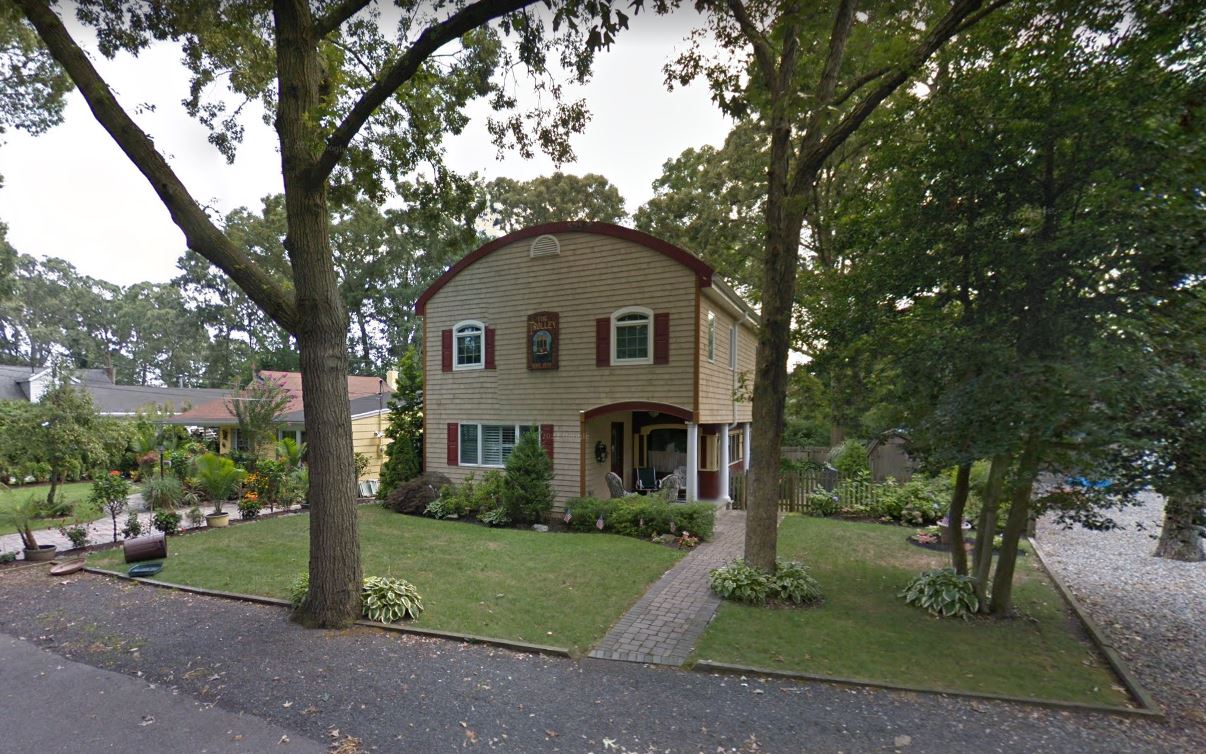
Soon enough, Sjonell, Kathy and their three children took over the trolley house, and the fun times continued with a new generation enjoying the house. (The family’s full-time residence is in Scotch Plains, where Sjonell retired as a guidance counselor.) “It stayed basically the same for the next 60 years,” says Kathy. “We only decided to expand when our six grandchildren began to appear.” In 2002, the couple decided to tear down the tiny house while leaving the trolley intact, a project easier said than done.

Eventually, they stumbled upon David Feldman of Feldman & Feldman Architects in Wall Township. “He shared our love of the old car,” says Kathy. When Feldman sketched a two-story home that resembled a trolley car pulling into a station, the Sjonells knew they had found their architect. “That was it,” adds Sjonell. “Feldman was the man.” Adds Kathy, “He maintained the integrity.”


and this beauty of a home and trolley car, will be the family weekend get-a-way, long after that sailor is forgotten. Some of our actions can have long lasting effects, but very few, and usually, only if our families treasure them. So, if you want to be remembered for centuries to come, you must build or create something that will last, AND be treasured. 

A home in Hamilton NJ was built around an 1914 trolley car, #288


A house had been built around a trolley car, obtained in the 1930s, soon after the Trenton trolley line stopped running, to make a house


Over the years, additions were made to the home, creating rooms off the trolley to expand the living space. Eventually, the trolley car was surrounded by a traditional house, located in a traditional neighborhood 


 It had been manufactured in Philadelphia by the J.G. Brill Trolley Company in 1914, and made its way to New Jersey, where it was part of the once-extensive trolley system operated by the Trenton & Mercer County Traction Company

 The plot of land that held the home had been purchased for a dollar by John Guthrie, a local typesetter, in the early 1900s. After his brother William traveled around the United States and came home broke, Guthrie and two of his siblings pooled their funds to purchase an old trolley to house him so he could get back on his feet. 

William expanded #288 into a proper house with the trolley at its heart, and it was eventually passed on to his nephew, John Breece, the elder Guthrie’s grandson, in 1952. He inherited the house and at that time it had an outhouse and a pump in the kitchen.

Liberty Historic Railway, an organization that supports transportation preservation projects, bought the trolley and is funding most of its restoration relying on donations and grant money to fund the rest of the restoration, which will cost nearly $1 million.

Contractors will restore the trolley at its new Farmingdale location by repairing weather damage and alterations from when it was inside the house, Strohmeyer said.

“What was amazing was just how remarkably intact it was, and because it was inside a house, structurally what’s left was actually very solid,” he said.


the shades have never been removed


the non-profit Liberty Historic Railway and the Seashore Trolley Museum, located in Maine, are working together to raise funds for the first part of the restoration process. The non-profit and museum have launched a GoFundMe campaign to offset the cost of re-creating blueprints and restoring the trolley car, which is currently in Southampton. 

The museum has commissioned a new set of construction drawings for the trolley. Funds raised through the campaign will go toward offsetting the cost of producing the documents and materials needed to restore the missing ends of the car. 

“It’s one of a kind and its the only surviving trolley car from the state capital,” said William McKelvey, director of Liberty Historic Railway Inc. “So we felt it was imperative to save it for future generations.”


Spring 2000, a Pennsylvania Railroad Class PB Passenger Coach, better known as "The Seaside Car"