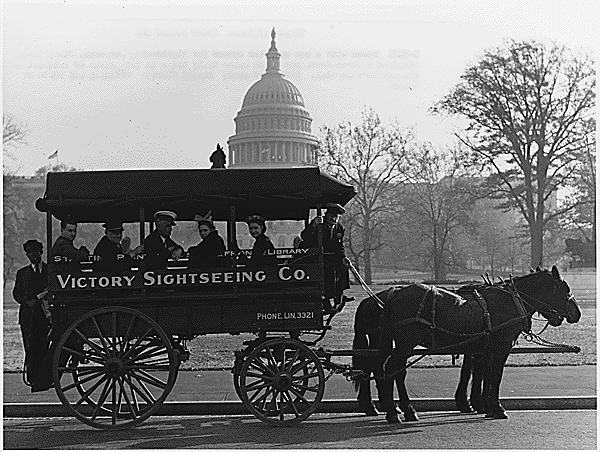
The reduction in speed saved fuel and doubled the life of tires compared to speeds of 60 miles per hour. Victory Speed had an effect on nearly everyone, but was particularly difficult for a few factory workers in states like Kansas and Ohio, some of whom were traveling 80 miles or more to and from their jobs at Beech, Cessna, or Goodyear.
The power to set speed limits historically belonged to the states, and the sole exception to this occurred during World War II, when the U.S. Office of Defense Transportation established a national maximum "Victory Speed Limit" of 35 miles per hour, in addition to gasoline and tire rationing, to help conserve fuel and rubber for the American war effort.
Although it was disregarded by some motorists, the Victory Speed Limit lasted from May 1942 to August 14, 1945, when the war ended
WAAC (Women's Army Auxiliary Corps) photo:
Even though there was no gasoline shortage, gasoline rationing was introduced as a way to curb excessive driving, which, in turn, preserved tires, because the real problem was lack of rubber for tires, since the Japanese had overrun the rubber plantations of the Dutch East Indies – where the US imported 90 percent of its rubber.
Finally, the victory speed was introduced to conserve tire tread.
From the fall of '42 until June of '43, officers could not arrest or prosecute anyone for exceeding 35 miles-per-hour, because the official limit remained at 50, but the rationing authorities were known to take away gas-rationing coupons from speed violators.
Later that year, in Cass County, North Dakota, a speeder got arrested and fined, on December 8th, for exceeding the limit, and he appealed his case all the way to the state supreme court. The court eventually ruled that Governor Moses had exceeded his authority in changing the speed limit, and, thus, the court overturned the Victory Speed limit and the speeding ticket.
And so the Dakota speed limit reverted to 50 in December of 1944. The governor, being slowed by the courts, said he would not try to impose the Victory Speed limit again.
Grumman ran a warning to workers, showing a photo of a Nassau police lieutenant questioning a factory worker who had strayed five blocks from his work-to-home route. Nassau and Suffolk police told Grumman there would be no “second chances” for drivers. The Sunday before, five Grummanites had been caught “joyriding” and permanently lost their gas ration coupons. Police were known to cruise the parking lots of taverns, bowling centers, and “other places of amusement” for cars that were out of place.
Another sticker in the windshield of WWII automobiles was a Wartime Motor Vehicle Use Tax stamp—a new one every month. The tax varied by the time of the year, drivers paying between 42 cents (June) and five dollars (July) per month to own and operate their car. July’s $5 fee was roughly equivalent to $76.00 in today’s dollars. The tax on automobiles in America was initiated from February of 1942 and lasted until well after the war had ended, in June of 1946. For those who paid for their car monthly throughout the entire war (and beyond) they shelled out $136.43, equal to roughly $2,080 in 2021 dollars.
The motor vehicles referred to in the act included automobiles, trucks, and motorcycles that used public highways. Motor Vehicle Use stamps were sold at post offices.
This tax was instituted largely to encourage people to take public transportation.
And those that purchased the stamps, were contributing the war effort. According to the commissioner of Internal Revenue, the motor vehicle use tax affected more individuals than all other categories of federal taxes combined.
Available information on the estimated distribution of ownership of family automobiles by family income groups in 1935-1936 indicates that almost 52 percent of the passenger cars were then owned by families with annual income of not more than $1,500. A comparison of the $5 automotive use tax with average automobile registration fees in the States reveals that the $5 Federal-use tax is equal to 27 percent of the average State registration fee in one State and 195 percent in another…
“Data on the distribution of motor vehicles by community-size classes, indicate that more than half of the burden of the $5 use tax falls on communities with 10,000 persons or less and that 31 percent of the burden falls on those living on farms and in unincorporated areas.”
The stamps for 1945 and 1946 show Daniel Manning, a banker, journalist and Democrat politician who served as secretary of the Department of the Treasury under President Grover Cleveland from 1885 to 1887. Manning was also pictured on an 1886 silver certificate. Why the Liberty Bell was replaced by Manning, someone who really had made zero mark in history, is unknown. No doubt, a relative of his got that done around midnight with a bribe. It really would be interesting to know the truth
Coast Guard Boat stamps were once required in 13 states and Washington
Fees, frustrations, and slowly fading tires curtailed the number of private cars on the road significantly. By 1945, household car ownership in the US had dipped to around 73 percent (from 88 percent in 1941), a rate roughly equal to Great Depression numbers of 1935 and 1936.
Ancient varieties of tires were not rationed, leading some workers to appropriate outdated Ford Model T type automobiles. Model Ts debuted in 1908. As Douglas’ periodical put it, “nobody will steal it and he can eventually sell it to the movies, if it does not fall apart on him some day.”
Goodyear employee Donald Ladd had a Model T nicknamed “the vibrator.” He bought it for $10 because the original owner preferred that the machine not go into the junk pile. The 1923 vintage automobile never let Ladd down, even chugging to work in sub-zero Ohio temperatures.
By mid-1941, Congress was addressing the prospect of being drawn into war.
In order to pay for all this, the Treasury Secretary went to the House Ways and Means Committee on April 24 to ask for an additional $3.5 billion per year in tax revenue for national defense. At the afternoon session that day, Assistant Secretary John L. Sullivan proposed to raise the $3.5 billion per year one-third from progressive income tax, one-third from corporation income tax, and one-third from excise taxes on commodities.
Of the excise taxes, Treasury proposed raising tobacco taxes enough to raise an additional $200 million per year, increasing alcohol taxes enough to raise an extra $178 million per year, and increasing the gasoline excise tax by 1 cent per gallon (from 1.5 cpg to 2.5 cpg), which would be enough to raise an additional $255 million per year.
After Treasury had presented the Administration’s revenue plan, the committee adjourned for the weekend. The following week, they held open hearings. Motorist and trucking groups showed up at the Ways and Means hearings prepared to oppose the Administration’s gasoline tax increase, but by that point, committee chairman Robert Doughton (D-NC) had released his own proposal, which killed the gasoline tax increase in favor of a new tax on the operation of motor vehicles and boats
The tax was opposed by the Roosevelt Administration. Assistant Secretary Sullivan gave the Senate Finance Committee a list of objections to the House-passed bill that sound familiar even today:
“The proposed tax has no relationship to the extent or use of the value of the object taxed and, therefore, is unusually inequitable.”
“…if [a driver] uses [a car] on 1 day in the week we charge him just as much as the taxicab that runs 24 hours a day except when it is laid up for repairs.”
“It taxes a $5,000 town car exactly the same $5 as the fifth-hand car worth only $20.”
“This proposed use tax must be collected from 32,000,000 taxpayers located throughout every State and county in the country. This would require an additional personnel in the Bureau of Internal Revenue of at least 3,800 new employees. The administrative cost is estimated to be $9,600,000 or approximately $6 of every $100 of tax collected, which is more than five times the average cost of collecting other excise taxes.”
In response to the Administration’s objections, the Senate amended the bill so that most of the administrative cost was borne by the Post Office
In the State of Arizona, which has a small population, law enforcement apprehended more than 7,000 delinquents. Practically all of the 7,000 submitted $5 offers in compromise rather than take the cases into the Federal courts.


.jpg)
.jpg)
.jpg)


.jpg)