Showing posts with label Boy Scouts. Show all posts

Saturday, January 03, 2026

George Jelinski, Eagle Scout of Poland, on his round the world tour (good idea for "scouting" as learning self preservation is inescapable while driving around the world) stopping at San Fran city hall in 1928


Jelinski left Warsaw on May 30, 1926, in a white Ford that was named “A Scout Is Clean”, paying all expenses of the trip by lecturing and writing articles for Polish newspapers. (That's a long name for a car, but the clean white thing is quite clever)


Jelinski's tour took him through Czechoslovakia, Hungary, Austria, Yugoslavia, and Italy where he met with with Benito Mussolini, and Sicily, where he embarked for the North African shore. 

He drove through Tunisa and Algeria to Casablanca in Morocco, and had traveled about 19,000 miles, the mileage being attested to and verified, by various foreign automobile clubs.


He left Casablanca for America on an export steamer, arriving in Manhattan in August.  In Washington he was greeted by President Coolidge in Sept. When he arrived in Detroit, Jelinski was received by the Polish consul for Detroit, who presented him to the Mayor. (Detroit had a large Polish population)

He addressed several Polish-America organizations during his several days' visit here. The Polish Falcons of District 13 raised the funds for a new Buick to replace the light weight Ford model T he had worn out

The happy presentation was made by the owner of Stanley Krajenke Buick, who also presented Jelinski with a membership in the Detroit Automobile Club, the seventeenth organization of its sort which has welcomed him since he left Warsaw. 

JFK was photographed in front of Krajenke Buick 30 some years later


Jelinski was also welcomed by James E. West, chief Scout executive of the United States, on behalf of the 870,000 Scouts in the United States. From Detroit his route was through Toledo, Buffalo, Cleveland, Chicago, Milwaukee and other cities.

He continued his journey to San Francisco, and left on the ship Taiyo Maru, and on July 13 arrived in Hawaii, then rode to Japan, where he traveled from Yokohama to Kobe, arriving there in mid-August 

He planned to return to Poland through China, but there was a civil war going on there, and he gave up the idea of ​​traveling to India at the last moment due to insufficient financial resources. Jeliński left Japan around September after visiting Nagasaki, then set out for Shanghai, Hong Kong, and Singapore.

The expedition was described in the book "Under the Polish Flag by Car Around the World" published in 1929 by Władysław Umiński.  The book is free online, but in Polishhttps://www.ee.pw.edu.pl/~kwestorm/jelinski/uminski_jelinski.pdf


His grandson made a replica of the Buick


a replica of the Ford is in the Museum and Centre of the Scout Movement in Krakow


After his time in the scouts and his round the world tour, he was a sailor and returned to the USA, going to Hollywood to learn to be a cinematographer. He studied modern film techniques and camera operation in Hollywood, becoming a professional cameraman.

Returning to Poland in the mid-1930s, he founded the Laborpat company, which dealt in film processing and production.

During World War II, the Germans confiscated equipment from Laborpat, destroying the company. Jeliński was participant of the Polish-Bolshevik War, and member of the resistance movement during World War II. 

After WW2, he established a rickshaw and handcart factory. 

He died in 1986

https://forums.aaca.org/topic/341211-period-images-to-relieve-some-of-the-stress/page/433

It's uncommon to find photos of Boy Scouts as they are too young to drive, typically. I remember the ones using a wagon to hike from Minnesota to San Francisco for the 1914 Pan Pacific Expo though https://justacarguy.blogspot.com/2016/01/1914-kids-were-made-of-tough-pioneer.html


The scouts on the Lincoln Highway with a covered wagon in 1928 https://justacarguy.blogspot.com/2019/03/i-think-i-posted-this-before-but-cant.html

in a 1927 article, U. S. Boy Scouts trekking through foreign lands were mentioned:
Sixteen Eagle Scouts from Wayne, Pa., were welcomed by the acting Lord Mayor of London.
Eight Sea Scouts from Chicago constitute part of the crew of the John Borden-Field Museum expedition, now collecting fauna in Arctic regions.
Two Scouts from Excelsior, Minn., are officially carrying greetings to Denmark.

In 1926, the following outstanding men were made honorary scouts:

Roy Chapman Andrews
Robert Abram Bartlett 
Frederick R. Burnham (horse mounted messenger for Western Union, actual US Cavalry scout, taught by native American Army scouts, fought in the Boer wars, and then taught Baden Powell trail signs and woodcraft, then went gold prospecting in the Yukon, and wrote his excellent biography, that I've read and have a copy of and recommend, Scouting On Two Continents https://www.facebook.com/groups/1491191564434558/posts/1514731728747208)
George K. Cherrie 
James L. Clark 
Merian C. Cooper 


Lincoln Ellsworth, polar explorer in above airplane, which was once buried by an 8 day blizzard, and he dug it out, with a teacup. The only implement he had at hand
Louis Agassiz Fuertes 
George Bird Grinnell 


Donald Baxter MacMillan, arctic explorer next to his tracked vehicle, 1927
Clifford H. Pope 
George Palmer Putnam, Amelia Earhart's husband
Carl Rungius
Stewart Edward White 

Of the 294 men and women selected to be astronauts since 1959 to 2005, more than 180 have been Scouts and of the 27 men to travel to the moon on the Apollo 9 through Apollo 17 missions, 24 were Scouts, including 11 of the 12 men who physically walked on the moon's surface, and all three members of the crew of Apollo 13 mission, that had it's oxygen tank explode meaning the landing mission had to be aborted.

Sunday, November 30, 2025

the publication of "Adventures in the Wilderness; Or Camp-Life in the Adirondacks" in 1869 started a flood of tourists to the area, development of stage coach lines, and the Adirondack Railway from fashionable Saratoga Springs to North Creek some 50 miles northwest. In 15 years, over 200 hotels had sprung up


Because the rich rarely remained that way, most of the wealthy family lakeside cabins were sold to the state, fell into disrepair from lack of funds, or destroyed because of something known as the Forever Wild clause in the New York State constitution. Some have been demo'd so the rich could build newer places.

Thirty-five “Great Camps,” still remain.

There is only one publicly owned Adirondack Great Camp whose buildings are open to all. Camp Santanoni on Newcomb Lake. 

for over 20 years there has been a horse drawn wagon service into Santanoni’s main lodge for thousands of individuals who could not bicycle or walk the 4.8-mile dirt road.


Santanoni’s first owner was a prominent Albany banker and businessman. Amassing some 12,500 acres in the Town of Newcomb, just south of the Adirondack High Peaks, Pruyn employed a distinguished architect to design his Adirondack camp. Most of Santanoni was completed between 1892-93


A number of architectural features of Santanoni’s main lodge have been described as Japanese in their influence. This was no coincidence. Robert C. Pruyn had served as secretary to his father, Robert H. Pruyn, when the latter was appointed by President Lincoln in 1861 as minister to Japan. 

The Pruyns were well connected in the business, political, and social life of the Empire State. Among many other involvements, Robert C. Pruyn was aide to Governor Dix, President of National Commercial Bank (now Key Bank), and a Regent of the University of the State of New York. 

Theodore Roosevelt and James Fenimore Cooper, Jr. were among the many distinguished visitors who regularly visited the Pruyns at their Adirondack camp.


In 1883 one of the first families on Upper St. Regis Lake, that of the wealthy merchant Anson Phelps Stokes, would arrive in a "special parlour horse car direct from 42nd street to Ausable for $100."


 One party consisted of ten family members and an equal number of servants, "three horses, two dogs, one carriage, five large boxes of tents, three cases of wine, two packages of stovepipe, two stoves, one bale of china, one iron pot, four washstands, one barrel of hardware, four bundles of poles, seventeen cots and seventeen mattresses, four canvas packages, one buckboard, [...], twenty-five trunks, thirteen small boxes, one boat, one hamper", all of which was then transferred to wagons for the 36 mile ride to Paul Smiths, and thence by boat to their island campsite


Built in 1908 by prominent banker Archibald S. White on 35 acres overlooking Lake Osgood, White Pine Camp is known for a few unique factors. It was President Calvin Coolidge’s home for 11 weeks in the summer of 1926

Some camps had ice houses, and harvested from the nearby lake. Some of the lakeside mansions were built with bowling alleys, some were similar to small towns, with blacksmith shops, carpenters, carriage houses, and had 300 acre farms to provide for the employees, horses, pantries.


Eagle Island, Saranac Lake was built in 1903 by Harrison's Vice President, Levi P. Morton, he was instrumental in creating Greater New York City, merging New York City and Brooklyn.

Morton was the 22nd vice president, and he also served as  the US ambassador to France, as a U.S. representative from New York, and as the thirty-first governor of New York. 

Eagle Island is literally an island with a mile circumference, that’s home to the Great Camp’s buildings and Adirondack woods. 

It was sold to Henry Graves, Jr., a wealthy banker and industrialist from Orange, New Jersey, purchased the property from the Mortons. Graves is known for competing with auto manufacturer James Packard for ownership of the world’s most complicated watch. 

Graves eventually beat Packard by commissioning the Patek Philippe Henry Graves Supercomplication watch in 1933. In 2014, the Supercomplication set a new record price for a timepiece sold at auction.

In 1938 the owners gifted the camp to the Girl Scouts. 


Lake Kora is one of the most intact and well-preserved Great Camps in the region and sits on a thousand private acres, designed by William West Durant in 1898, and was owned by the Vanderbilt family


https://www.afar.com/magazine/retreat-like-a-rockefeller-at-these-spectacular-adirondack-lodges
https://www.adirondackexplorer.org/community-news/history-culture/historic-great-camps-that-you-can-visit/
https://www.facebook.com/groups/adirondackhistory


Robert Schroeder was from a German immigrant family, son of a brewery owner who prospered in America. He began buying land around Debar Pond sometime during the 1880s for raising hops, a major agricultural product in Franklin County during the 19th century.

In time, Schroeder was able to amass around 2,100 acres. He planted at least 300 of those acres in hops, sending them on to breweries in Utica and New York City after harvesting. At one time, he employed more than 100 people.

He was married to the daughter of another brewery owner, their home was a 60 room mansion featuring niceties like a mahogany staircase, a ballroom for entertaining, and imported stained glass. 

Things didn’t work out. He lost his fortune (and that of his wife), and had to give up his business and his Adirondack mansion in favor of much more humble lodgings in Brooklyn. As if the couple hadn’t been debased enough, they had to deal with an impetuous daughter who eloped with a member of Hungarian royalty.

Except the man turned out to be a fraud. The most royal thing he did was work as a salesman at a cigar store. The stress of losing her fortune, and then “losing” her daughter, devastated Schroeder’s wife. 
She committed suicide by gas asphyxiation. 
Not long afterward, her husband also killed himself that way. 
Interestingly, the fake Hungarian royal eventually did the same thing.

https://www.adirondackexplorer.org/community-news/history-culture/commentary-historic-debar-pond-lodge-deserves-preservation/

Two good sources for learning more about Debar Lodge are Harvey Kaiser’s recently updated “Great Camps of the Adirondacks,” and “A Guide to Architecture in the Adirondacks,” by Richard Longstreth.

Tuesday, February 06, 2024

Camp Winnataska's history began as Dr. Elwyn Ballard's afternoon excursion in a Model-T (in 1914) to a promising fishing hole. Enchanted by the waterfalls, he made a summer camp for kids in 1916 at the site


Dr. Ballard, Commissioner of Boy Scouts in Birmingham, and his wife, Florence, discovered this site and became vital forces in the founding and growth of the camp. 

Boy Scouts and Boys Club members from the area first camped here in tents in 1916. 

Through Dr. Ballard, the Interdenominational Birmingham Sunday School Association acquired the camp in 1918 and offered sessions not only for boys but for girls as well - the first organization-sponsored camping for girls in Alabama and among the first in the South. 

Winnataska early received national recognition for excellence of staff, facilities, and programs."

Wednesday, February 15, 2023

(coffee and donuts video) In 1955, three Scouts left São Paulo for Niagara-on-the-Lake, Ontario, Canada to participate at the 8th World Scout Jamboree in a 1954 "Horse Face" Willys Jeep. During the trip, the three scouts traveled about 45,000 miles in just over a year, through 19 countries


In the video, Hugo Vidal, one of the scouts that made the trip gave his take on the life-changing event some 65 years later. 

I can't understand him in Portugesuse, but it is a fascinating story for any Jeep diehard. I haven't been able to get the video to translate from Portugese to English 

the CJ-3B used in the expedition contained a number of parts and accessories, however, it had no mechanical issues on the journey what so ever.


The 8th World Scout Jamboree 1955 was the first major international gathering of Scouts outside of Europe.

the scouts were given this Willys CJ-3B for the adventure, through the efforts of J.B. Versteeg of Willys Brasil, who was involved in the Scouting movement and had met its founder Lord Baden-Powell at the 1929 World Jamboree in England

The Jeep was prepared with a 60-liter water tank, two spare 30-liter gas tanks, two spare tires, and a roof rack on the steel hardtop.


Between northern Colombia and southern Panama are the ancient swamps of the Darién Gap, impassable to vehicles. But Pan American Airways came to the rescue with a DC-4. With rear wheels and roof rack removed, the Jeep was loaded with only 2 inches of clearance, and flown to San José, Costa Rica, where the guys enjoyed the friendship of Costa Rican Scouts.

Shortly after leaving San José they faced the biggest shock of the trip; on a muddy wooden bridge the Jeep slid off into a ravine and turned over. But the steel hardtop possibly saved their lives, and the Jeep suffered only minor damage.

After the Jamboree, the guys drove back across the border to Toledo, Ohio, where they visited the Willys factory. They were still planning continue to Alaska, and the engineers at Willys found the 3B to be in perfect mechanical condition. 

They visited the Warn factory, which produced the free-wheeling Jeep system. Seeing an opportunity, Hugo decided to manufacture the system in Brazil. Talking to Warn executives, he obtained the license to manufacture and redesign the device.


The scouts had to raise funds for the year long trip, and found that Brazilian car parts companies were eager to trade parts and sponsorship money for the international publicity (70 years later and here I am helping at that!)

the CJ3B was disassembled and painted green and yellow (Willys' colors), and rebuilt with about 50% domestic parts, starting with bumpers (Valent Amortex), piston rings (Vibar Hastings), radiator (Bonani), filter oil (Irlemp), whip (Equiel), battery (Heliar), padding (Acyl), radio (Telespark), brakes (Gots), wheel hubs (Simetal), pistons (Cima), exhaust (Famor), canopy steel (Carraço), transmission gears (York), switches (Schenk), muffler (From May, Gallo & Co.), brake pads (Ferrodo Lonaflex), crankshaft (Angloamerica), springs (Fabrini), semi-axles (Cinpal), synchronizer rings (Esteves), and brake drums (MITEC Omega) made in Brazil.

The Jeep had used several tailpipes and eleven tires, but except for a shock absorber (whose rod bent after getting airborn), no Brazilian part was replaced.

The total expense recorded for the trip was USD $641, a figure far below the actual costs, due to services and lodging provided free because of the nature of the achievement.


Sunday, July 03, 2022

the Washington Post did a great story on the Boy Scouts in last weeks Amtrack crash in Missouri

Heading from Los Angeles to Chicago along Amtrak’s Southwest Chief line, the train was carrying 275 passengers and 12 crew members, when it hit a dump truck at a road crossing near Mendon, derailing two locomotives and nearly every train car. 

the Boy Scouts had spent 10 days exploring the backcountry of New Mexico, mostly by backpacking through the Sangre de Cristo Mountains, and were on their way home to Appleton, Wis.

The collision caused some of the Scouts from Wisconsin to lose their phones, AirPods and even their shoes, Skrypczak said. Eli and the others collected their wits, made sure they were all accounted for and started helping people.

First, the Scouts secured passengers who seemed like they might have spinal cord injuries, his father told The Post. Then, they started popping out the train car’s emergency windows. When some became stuck, the Scouts used their shirts for protection and broke the glass. They evacuated everyone they could.

After that, Eli ran to the front of the train to see if anyone was injured, his father told The Post. He learned the train had hit a vehicle when he saw wheels or an axle near the tracks. Then, in a ditch, he spotted a man who turned out to be the driver of the dump truck the train had just hit, whom authorities identified as Billy Barton II, 54, of Brookfield, Mo.

He was hurt — badly. He was bleeding and, although he was breathing, the man was gurgling. Eli gave him some water and tried to stop the bleeding. He told the driver that help was on the way. He held his hand. Soon, a local farmer joined Eli as they tended to the dying man.

Eli and the farmer kept up their efforts until emergency crews arrived, something that probably took minutes but “seemed like a lifetime,” Skrypczak said. The first responders eventually told Eli and the farmer it was time to “call it” and “attend to the living.”

“And that’s what Eli and the boys did,” Skrypczak said. Eli jumped into the fray. Since the crash, Skrypczak said, he’s been getting messages from others at the scene who remembered Eli as the kid pinballing between firetrucks and the crash site to resupply paramedics. Based on what others have told him, Skrypczak estimated his son made 100 trips.

“As a dad and a scoutmaster, I’m unbelievably proud,” Skrypczak said.

But Eli was just one of the Scouts helping, he added. Some performed first aid on their own scoutmasters who had been seriously injured. Others hauled passengers on backboards from the crash site to ambulances. When paramedics stopped them from doing that for the more seriously injured patients, the Scouts stripped out parts of the train car that might block rescue workers from getting people out of the wreckage.

Eventually, emergency crews ordered the Scouts to go to medical staffers for assessment. All of them ended up going to the hospital, although none were seriously injured. Most are dealing with soreness and bruising. Some might have whiplash and a cracked rib or two. “But nothing serious,” Skrypczak said. “Some of these kids have certainly had worse on the athletic field.”

Friday, April 01, 2022

someone had a problem photographing this truck from front to back.

 
https://www.hsraa.org/museum.php?action=exhibit&id=117

Thanks to Scott, for sharing these photos of the Yawgoog Scout Reservation ( Rockville, RI ) fire fighting trucks! Founded in 1916, Yawgoog is the fourth oldest continuously run Scout camp in the United States.


Thanks again Scott! 


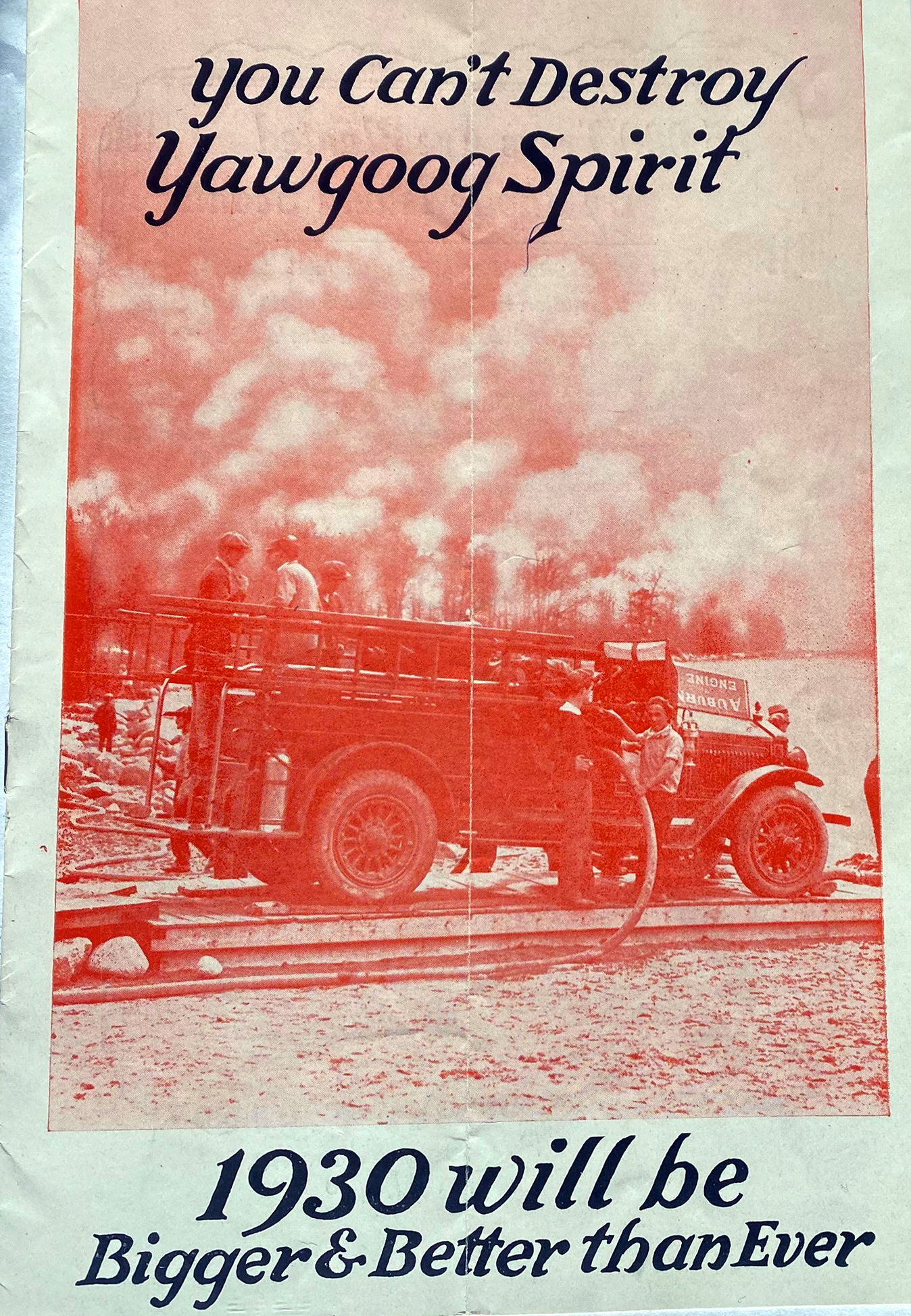
Here is a flyer handed out after the great fire of 1930:


After the Great Forest Fire of 1930, most of the forest and woods at Camp Yawgoog were left blackened and bare. The summer activities shifted from the wood to the water. Among the items added to the waterfront were two 28' Navy Cutters. The Cutters were extremely popular and survived into the late fifties

1968 – Dr. Charles Wilson Brown, retired Head of the Geology Department at Brown University, gave to the camp the rescue boat that now carries his name. Allan W. Halladay, Sr. created the “Peanuts” cartoon artwork on the boats hull with the blessing from Charles Schultz.


A couple of famous guys have visited the scouts at camp Yawgoog, Ted Williams and Archie Moore, https://www.yawgoog.org/uploads/6/8/4/2/68426127/yawgoog_story_-_vol_iii.pdf and strangely, both have a San Diego connection (where I live) and here I am posting about the one scout camp they both visited!  

A separate post about Ted Williams coming up soon